The Red Strings Club | a Review
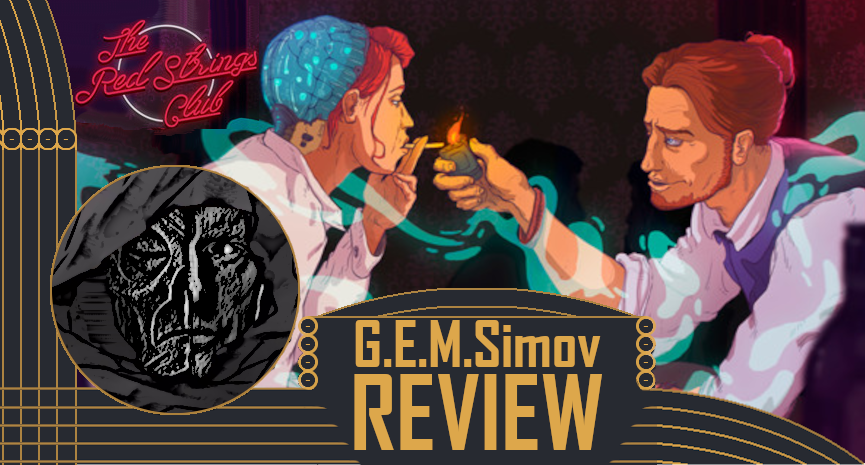
originally published on 13/12/2024;
Hello everyone, I am the chill and friendly bartender, G.E.M.Simov, a person so skilled at making cocktails that I’ve been banned from doing it ever again. I’ll be telling you why that happened as I review “The Red Strings Club”.
Simple review details - I rank games on an out of 10 basis, granting up to 3 points in 3 categories, as well as a last, single point from my own self, depending on my experience with it.
Gameplay
The Red Strings Club, henceforth RSC, is a wonderful job simulator game in which the Player takes on the role of a Bartender who talks to patrons and mixes drinks on occasion. There’s also another role that gets filled for a bit, but more on that a bit later.
RSC is a point-and-click adventure game that features a number of neat mini-games that make up the gist of the gameplay, while the rest is all dialogue, mountains of dialogue. So, that means there are at least two modes of play, right? Indeed, there are two modes of play, though it could be said that one of them features a lot more than the other.
First is the world mode - which features the Characters (and the Player Character) in a location. The Player interacts with things by clicking them, which brings up a text box that informs the Player of what has happened OR presents dialogue, if the clicked object was a Character or a Character reacts to it being clicked. The world mode is relatively simple in what the Player gets to do with it, mechanically, but it mostly serves as the vehicle for the story.
The other mode of play is the mini-game mode. This is the mode which the game enters whenever proper gameplay is going to be taking place, be it mixing cocktails or shaping pots (don't ask). I said that it is possible to have more than two modes of play, and that is because the mini-games are so different from each other, at least mechanically, that they could be interpreted as different modes of play. Regardless, I would like to describe some of them.
As the game is a point-and-click offering, it makes use of the mouse for almost everything, if not straight up everything. Thus, it capitalized on the potential of the mouse. The first mini-game, the cocktail mixing, presents the Player with a glass and a bunch of bottles, as well as a number of circles.
The circles are two types - one is stationary and indicates a possible objective, while the other type is mobile and indicates the effect of the drink. The goal is to mix a drink that overlaps with one of the stationary circles. For that to happen, the Player needs to add one of the four (increasing in number as the game progresses) alcoholic beverages. Each moves the mobile circle in one of the four directions, those being up, down, left and right.
The way pouring works is by clicking the bottle (with the Left mouse button), which picks it up, then clicking again and holding down the Left mouse button, which changes the cursor to indicate that the bottle is going to get rotated. Then the Player just moves the mouse either left or right, depending on where the bottle is relative to the glass, and out comes the liquid. Lastly, there’s also ice, which makes the circle smaller. That mini-game is really neat and it’s very fun to go through, especially when more stuff is added.
Then there is the pot shaping mini-game. It works very differently from the cocktail mixing one, because it relies on other… Things? In short, the Player is provided with a cube of stuff. That cube has an outline in it - depicting the shape it must take on - and the Player has three chisels. One chisel is smooth and round, another is sharp (like an arrow), and the third is shaped like a rectangle. For the purpose of this mini-game, the only thing the mouse's clicking does is make the brick spin, allowing it to be molded and shaped.
The chisels are selected by moving the mouse's cursor, represented by the Player Character's hand, and pressing it against the corresponding buttons on the screen (diegetic UI, amazing). Then, the chisels are just guided towards the brick by dragging the mouse, and are used to shape it, again, by just dragging the mouse. It's quite neat.
That’s my stance on pretty much all of this game’s gameplay. It is quite neat, it is not too complex, though it does require some effort to deal with. It’s entertaining enough, although its simplicity is a bit bothersome.
The simplicity gives way, if only slightly, when it comes to the dialogues that can be had in the world mode. Those are affected by the drinks presented to the Character with whom the Player Character is conversing, allowing for vastly different responses. That allows for a measure of replayability and also involves careful consideration. Is this person going to react to that question well if they are scared, or will they react better to it if they are calm?
Regardless, the game actively wants the Player to pay careful attention to the conversations that are taking place, because after each visitor to the bar a quiz, of sorts, will take place, and if the Player gets 70% of the questions right, they get a new… Ingredient, I suppose? The game markets it as a skill, but, in reality, it is not that. It’s a usable item that is flavored, by the game, as a funky additive for the cocktails.
Unfortunately, there are 4 instances of the cocktail mixing mini-game and 2 instances of the pot shaping mini-game, which is a bit unfortunate. All that design, all that thinking going into something that’s barely utilized? A shame, really.
With all that said, the game does not actually support that much replayability. Playing through it once is more than enough to experience the overwhelming majority of the content it offers, with the exception of some alternate dialogue options. Overall, though, the game is not that engaging via its gameplay, even if it is neat to do for a bit. There is no endless mode that features just making drinks for people, though, and I feel as though that is a missed opportunity. 2/3
Presentation
RSC is a sublime in appearance game. It looks wonderful, in part due to the fact it relies on pixel art to show its visual elements, in part because of the incredible crispness that the visuals have. While the game is reminiscent of old ones that had no other option but to rock the pixels, it does not actively emulate any one of their “time period” appearances. It has incredibly high fidelity, with everything being crisp and well defined, even if made up of discernible squares.
This is the main thing that this game does well - it is phenomenally crisp, whilst also being very comfy. The visuals, whenever a location is being presented, are almost always subdued and calm, relaxing but also indicative of a sadness or melancholy that is right around the corner. That is further enhanced by the music and sound effects employed by the game, which are very, very good.
I’m actually properly impressed by both the SFX and the score for RSC, and I must admit that I spent a decent amount of time with the game open in the background so that I could listen to its sound, be it ambient or musical.
The SFX contribute to that crisp feeling, as well, and then the visuals continue to seep into it. This being a game that relies on text boxes to convey what Characters say, it features some of the most sleek and stylish such User Interface objects I’ve seen to date. The font itself is very pleasant and the sound that accompanies text’s appearance (as though the character is speaking) is also, in most cases, quite neat.
It is important to note that the music, and some of the SFX, are very, very loud. The volume can be lowered, but it is a bit ridiculous how loud they are by default.
I’m singing this game too many praises, perhaps, but the visuals and the atmosphere they create are phenomenal. The folks working on it definitely went out of their way to make a cozy club, and that’s an achievement in and of itself.
Now, when it comes to the way the cocktail mixing section looks, it’s a lot brighter than everything else. That makes sense, because the Player needs to see what’s going on clearly, though there is never any real need for incredible clarity. That, which needs to be visible, is visible, and the slight shift in gamma is a tad jarring.
The same applies to the rest of the possible mini-games, though they’re not as bright as the cocktail mixing stuff. Regardless, this one issue pales in comparison to the goodness that the rest of the game brings with itself. After all, it happens to have a journal, in which everything is written down.
That journal is really neat. Definitely tugs on whatever strings I’ve got in me, because it brings a vibe I absolutely love. Journals in games are great, because they don’t just present the story, or what’s happening, but they attempt to do so through the eyes of one certain character. Perhaps I am infatuated with journals in games because of Planescape Torment, but it’s really cool.
Not only that, but it features detailed explanations of what many gameplay elements - mainly related to the cocktail mixing mini-game - do, which is information that the Player could get through trial and error, or they could just read up on stuff. Now, I say information - but the way the game conveys information is really smart. The bottles that take part in the mixing mini-game have directions incorporated into their design, taking away the need to actually read the journal - just look at the arrows on the bottles!
That’s monstrously diegetic, and I love that kind of stuff in games.
Lastly, the tutorials are also quite good, also presented in a nearly diegetic manner, although the fourth wall does get broken up by the mention of clicks and such. Regardless, this game’s Presentation is absolutely phenomenal. 3/3
Story
The Player takes on the role of Donovan - the bartender of the Red Strings Club - and generally follows his story, though that winds up intertwining with the stories of one Akara and another Brandeis… Well, actually, the Player might be taking on the role of a muse, which is… The Player?
So Donovan channels esoteric powers to get himself a muse, and that muse can see people’s souls, allowing Donovan to make just the right cocktail for the guests, allowing them to really get into a contemplative state… And making them a lot more talkative. That’s already an interesting premise, but it is not all.
The Red Strings Club is situated in a city ruled by corporations in the distant future. Everything is very cyberpunk-y, there are people with augments, and yet the Red Strings Club looks like it’s straight out of 2015, with Donovan using a notebook to write things down. Donovan’s buddy - Brandeis - is a bit of a loose canon, a bit of a scoundrel, and… Well, he’s very human, and he likes justice, be it social or otherwise. So, Donovan’s buddy does funky work to mess with the big corporations and companies around town, while Donovan gets information out of influential people - after all, you don’t make cocktails for just anybody when you serve tequila of a variety that gets 80 bottles produced annually, worldwide.
That’s all well and good, but one evening a busted up android walks in. Akara-184, the first android model capable of making ethical decisions! Well, Brandeis checks it out (because he’s somewhat of a hacker) and finds out the super-corporation behind the Akara androids is planning to do some mind-controlling on everyone with an implant - and that same corporation is planning on making implants so easily accessible that, by the time they get to mind controlling folks, 99.7% of the population will have implants.
So Brandeis decides he is going to become a revolutionary, but Donovan (who is very gay) is not keen on having Brandeis go and get himself killed, so they agree on allowing the bartender (who is super gay, like wow) to gather some information to see if the situation is as serious as the newly anointed revolutionary thinks it is.
The game follows these two on their adventure, as Donovan uncovers intel and Brandeis prepares a funky infiltration with the goal of hacking into the giga-corporation’s systems and getting rid of the “world domination mind control” plan.
The story is very pleasant to go through, and has some really neat, and transparently obvious, anti-corporation, anti-capitalist messages that it carries. However, it also makes it a point of showcasing that everyone is human - even those fellows who run the corporations - and that their circumstances are what makes them do most things they do, rather than their morals and ethical codes.
It is very neatly done. It asks some very interesting, and frankly important, questions, questions that seem to be gaining relevance with great intensity as time goes on.
That said, though, there’s something about this story that just doesn’t feel perfectly right. I can’t quite put my finger on it, because it’s actually very good, but there’s something that’s off about it. Maybe it’s the overwhelmingly intense anti-corporatism that it’s rocking, which is so one-sided it becomes caricaturesque? Maybe if the uncertainty of the Characters and their doubts concerning their own actions and motivations? Maybe it’s the fact that the folks doing the bad thing are convinced it’s actually a good thing, or are at least content with doing it?
Yet all of those things are incredibly human. I should not be bothered by them, because these are perfect reflections of the world as it is…
Hold up, I know what bothers me. The game opens up with Brandeis falling to his death, so the stakes are not as high as they could be, and the conclusion is somewhat known. Granted, the mysteries that wind up uncovered are very interesting, but… Bah, I’ll concede. It’s fantastic. 3/3
Legendary Point
Does this game get the legendary point, so craved and wanted by all and none at the same time? In regards to what I was going on about in the Story section, I’ll say that NO, the game does not get the Legendary Point. 0/1
Conclusion
8/10. Actually a very good game. One of the few games that call themselves a Point-and-Click adventure that works immaculately and does not have solutions to its puzzles that come out of someone’s behind. I’d recommend it to anyone who likes cyberpunk, science fiction and point-and-click games. I’d recommend that it gets experienced by anyone who’s a fan of more than just one genre of games, especially folks who enjoy story-rich or story-driven things.
I tuck it under my belt, another shining achievement that I proudly display… If only there was an endless mode!