Activision-Blizzard's Diversity Space Tool | an Essay
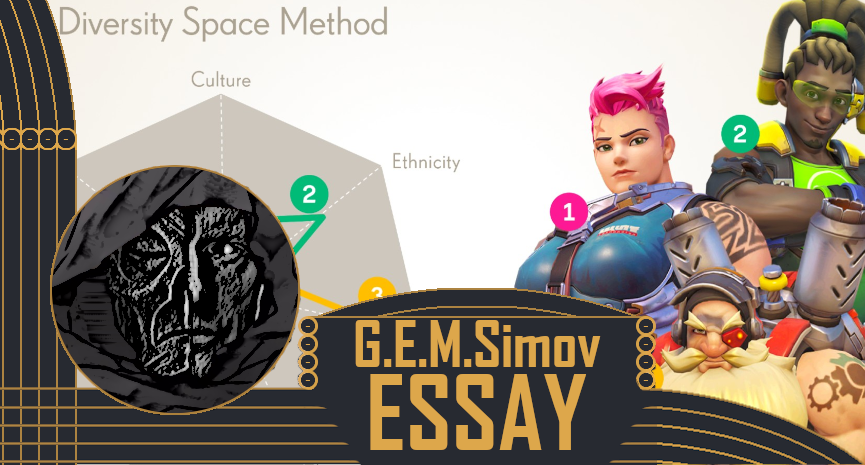
originally published on ??/05/2022
in response to Blizzard's unveiling of the "King's Diversity Space Tool"
Activision-Blizzard is a corporation that wants to make money. That corporation is run by a number of people, which people are more and more evidently totally disconnected from the things they are in charge of.
Ignoring the fact that the corporation is made up of companies that make video games, whilst the corporation’s goal is not to make video games, but rather profit; Ignoring the fact that the corporation is internally ordered in such a way that the people who know what’s what cannot affect the product; Ignoring the fact that the corporation is so horrendously crippled by bureaucracy that it has, by itself, implemented so as to make itself more financially efficient, at the price of product quality;
We are still left with the fact that this corporation, run by an incredibly tiny minority out of the large number of people who are working for the corporation, which tiny minority lives in a manner that’s unreasonably different from the manner of existence of the remaining part of the laborers in the corporation, which is owed up, but not exclusively, to the amount of capital at their disposal, is a projection of this minority.
As is known, whenever someone takes up a management position, they have an upper limit of how many people they can manage - because the management of people is difficult, due to the fact that one must interact with these people, one must get to know these people, one must get along with these people, and other such things - the upper limit is not very high. Thus, instead of solving this issue by devising a hierarchical system that makes sense, that functions in favor of quality, the folks at Activision-Blizzard - the ones running the show - have, as previously stated, chosen a system that focuses on quantity. Quantity of capital amassed, mainly.
And, to amass capital, it is most efficient to have many laborers producing products that can then be exchanged for capital. The more products at one’s disposal, the better. The faster they come by, the better. THUS, the focus of the hierarchical system at Activision-Blizzard is not on making things work well, it’s on making things work fast and cheap. That does not mean things aren’t working well, but the wellness is not associated with a dedication to quality, the wellness is associated with the dedication to quantity. It does work well, but only in its capacity of producing many things, and doing so quickly. It does not work well in its capacity of producing high quality things.
That, having been confirmed by the vast multitude of recently released products of Activision-Blizzard - all of which are created with an obvious focus on quantity(the speed at which they are developed and released onto the market), rather than quality - indicates the fact that the way things work in Activision-Blizzard is not ‘good’. Proof for that is the phenomenally stupid “Diversity Space Tool” that was unveiled recently.
I am not finished, though. See, the upper management - those running the big corporation - are very few. Whether it be a board of directors or some other obtuse organ for government (of the corporation or company or whatever - as said, it is all obscenely obtuse, purposefully), it matters not, but what matters is that the hundreds of people working in Activision-Blizzard… Actually, no, the thousands of workers of Activision-Blizzard are viewed not as people by these leading figures, but as pawns, as a resource.
After all, no one man can know thousands of people and perceive them as people in an adequate capacity, right? Well, that’s how it works, as is evidenced by the results. The big boys stand on top, and under them - likely managed by each of the big boys - are a number of smaller boys. Let’s say that each big boy manages 10 medium boys. Well, each medium boy manages 10 small boys, and each small boy manages 10 diminutive boys.
That means the big boys only know the medium boys, and only treat the medium boys as people. That might not be true, as the medium boys could not be treated as people, for who knows how people in power treat their subservients, but let’s pretend it is. That’s all well and good, but then the remainder of the boys under the medium boys - the small boys, the diminutive boys, and, perhaps, even the micro boys, if there are any of those - those aren’t people, those are abstract concepts in the head of the big boy.
Those aren’t people, those are just Human Resources. See? Not people, resources. And, well, considering that’s the way the big boys interact with their underlings - they tell the medium boys to do X job, and then that’s as far as the big boys’ involvement goes. The remainder of the boys who might need to work on X job? Good luck to them, I suppose. And, of course, there’s no way of telling the big boy that job X is not a good idea, unless if you are a medium boy. Well, maybe there is a way of doing that, but if you’re a small boy, you need to tell medium boy and hope that medium boy decides that they’ll get that passed - but bureaucracy will make sure things don’t actually pan out, don’t worry.
So the thing seems to be that the big boys at the top are disconnected from the workforce they’re managing (directly and/or indirectly). They are, however, not disconnected from just that. They’re also disconnected from the rest of society in a very similar capacity. They have their friends - maybe 25 people, at most, with whom they interact often enough, and then there’s maybe another 30 or 40 with whom they interact every year or so - and that’s a very tiny circle. Considering the fact that at least 25% of all those people are directly related to the big boy, those people are, probably, experiencing a very similar type of existence as the big boy. The remainder would, probably, also be experiencing a similar type of existence to the big boy, because a person that goes to X type of establishment and X type of event is not likely to meet and befriend a person that goes to Y type of establishment and Y type of event.
In short - the big boys, the people in charge - they’re not equipped to handle any issues that do not directly affect them. One such issue, as is confirmed by the “Diversity Space Tool” is ‘Diversity’.
What has happened? Well, the big boys who run the corporation, due to the fact they don’t know any people that are ethnic minorities, or some other kind of minority, decide that the best course of action, when it comes to satisfying the market, is to find a way to make the consumers (who aren’t people, mind you, they’re sources of capital) happy. The best way of doing that is, of course, to devise a system, a set of profiles, a set of presets, if you will, that are going to be utilized from this point onwards in the production of the products. That’s a business move, isn’t it? Introduce a system that helps you deal with an issue. Of course, due to the fact that systems need to be rigid, they’re not that good at working for people, but that’s alright, because these systems aren’t meant to be utilized on people, they’re utilized on products!
Oh, wait a minute - you mean to tell me that the problem with diversity is… The people thing? What’s the problem, we’ve got this INNOVATIVE business solution that checks whether or not we’ve got our diversity value high enough to be satisfactory, and then–
That’s the problem. The Diversity Space Tool (DST, I suppose) treats this as a problem that’s not bound to the very humanity of the customers, but rather as a problem that’s bound to their likes and dislikes. Tokenism is not a good thing, as it is the practice of making only a perfunctory or symbolic effort to do a particular thing. Tokenism is pretending to be doing something, but not actually doing it, when it comes to social issues, mainly affecting diversity.
So this ‘innovative’ thing, the DST, grabs the characters appearing in the products of Blizzard-Activision and grades them on how ‘diverse’ they are. The more diverse they are, the higher their diversity value. Let’s see… Member of a minority, physically disabled and with a sexuality outside the established ‘norm’. That’s a very diverse character! Let’s give that character diversity value of 30.
Interesting, would you not say, that this character is measured not based on what kind of… You know, character they are, but on some metrics that, supposedly, don’t actually matter to what kind of person you are. Well, it’s alright, these characters aren’t actually people!
Oh, that’s not the problem? Oh, the problem is that these characters serve as a means of allowing ACTUAL people to identify with them? Yes, here’s the problem. The whole concept of ‘diversity’ in games and movies is based on the fact that people, when watching a movie or playing a game (which is them observing characters experiencing something, let’s say a scenario), seek out, subconsciously, a character in the movie or game, who is directly experiencing the scenario, and identify with that character.
You can’t understand another person if you can’t put yourself in their boots, right? If you can’t put yourself in their place? So the characters end up being treated as people, by their observers, and through that treatment of the characters (as people), the observers indirectly experience the scenario experienced by the characters.
So the characters aren’t just objects… They’re SUBJECTS. And that subjectivity of the characters makes them more human than not, done through the power(stupidity?) of the human mind. Right, well that indicates that these characters are somewhat human. The people observing these characters see themselves within these characters.
So, let’s make a character. We make the character, basing that character on whatever we want - we, essentially, create a person. Then Activision-Blizzard’s DST comes in and says, to the people working there and making characters: The average diversity value of characters in this product needs to be at least 23. It seems as though the only reason certain characters might be the way that they are is BECAUSE of the fact that they needed to be diverse enough to match the required average.
That character who’s a short-sighted, wimpy boy and was born in India? He’s that way because he had to match the diversity value. In a sense, his only value as a character is that he has that diversity value. What, then, happens when a person (a real person) comes to know of this? Well, if that person is not a member of any minority, to them it would be perfectly fine, perhaps, because it does not affect them.
However, if that person is a member of a minority, then that person would subconsciously, or entirely consciously, come to the conclusion that they are not ‘normal’. The norm, of course, is, let’s say, straight white people. That’s what you usually get in movies and games, supposedly. Does the fact that there’s only that kind of character in media mean that the media cannot be consumed by people who aren’t like that kind of character? No. Does it mean that the people cannot identify with that character? No, because a person is a lot more complex than just their skin color and sexuality.
But that complexity is a double-edged sword. Or, rather, a hiltless sword - as you wield it, it harms you. The member of a minority watching these movies will recognize that, hey, these movies don’t have people like me in them. Maybe I’m not normal? Maybe there’s something wrong with me?
That’s, of course, a very hypothetical, very fringe example, but there’s a very real possibility that an understanding of similar proportions can, and might have been already reached, by members of minorities. So then a movement to make that change was started…
But then another problem showed up. Let’s have ONE black character in this movie, and everyone else is going to be white, so that ‘THOSE’ people don’t complain about it. That’s an example, but a poignant one.
This does not actually solve the problem, though. If anything, it only highlights the problem - everyone else is such, and then that character is different.
So, what does this DST do? It essentially tells the developers, the makers of the characters, how diverse these characters have to be. What for? Well… So that it is easier to implement token characters into the products produced by Activision-Blizzard.
The humanity of the consumer, of the developer - that’s not something the big boys, the ones running the company, are concerned with. Thus, it does not matter to them if they fail to treat people as people. Look at this neat little system that takes away everything that makes somebody human and just attaches a value to them! It’s so ‘innovative’!
What, phrenology? The act of measuring a person’s humanity by measuring their skull? The conception of a person’s humanity stemming from their reason, and a person’s reason being directly associated with their intelligence? The less intelligent you are, the less reasonable you are, the less human you are? So like, what, phrenology placing a value on one’s humanity that cannot be affected by the one to whom it is attributed is bad, but you doing that with this DST is not?
IQ tests? The act of measuring a person’s intelligence through a test that fails to take into account a vast number of factors OR the complexity of humanity as a whole, What’re those, we’re uneducated in any field not related to the exploitation of workers and the accumulation of capital! Business! Let’s do BUSINESS!
From this exercise, I want the reader to take two things:
First, don’t ask yourself why you need to learn this in school. Almost everything you learn is helpful, and then everything you learn helps you become better at thinking. Every bit of knowledge helps you become a better person, and through that betterment you might even learn how to treat people different from you like people. Just a hint!
Second, I don’t like the way corporations are run. If democracy is so valued on a societal level, why don’t we apply some democracy in other fields, ones that take up a majority of our lives - such as work?