Champions get beaten on Saturday | A Review
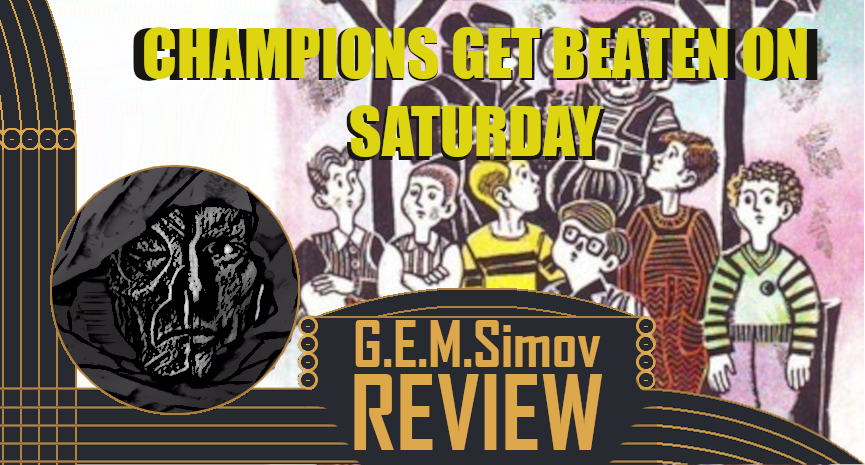
Hello everyone, I am the not-soccer-enthusiast, G.E.M.Simov, a being that reads, here to tell you about the soccer-enthusiast book by Bojidar Tomov “Champions get beaten on Saturday”.
Simple review details - I rank books on an out of 10 basis, granting up to 3 points in 3 categories, as well as a last, single point from my own self, depending on my experience with it.
Content
This is a children's book. In fact, it might actually be a children's book for kids who are just getting into puberty - though, ultimately, all of that is somewhat secondary to what the book is really about. It is about the past - because the book was written not just in the previous century, but it was written during, or shortly after, the “socialist” regime.
That makes the book less of a children's book about growing up and learning how to deal with problems, or a children's book that presents the reader with a role model, though both of those are present… No, this book winds up being a bit of a history book for kids. It is still for kids, because it not only shows off children-based oddities, but it also features some completely deranged segments that would only make sense when on them is layered the imagination of a child.
Thus, this book tells of that strange and somewhat alien time of “socialism”. It shares the wondrous times that had kids playing in the yards between the massive apartment complexes, until dark and with no supervision, with the only control their parents had over them being the act of popping out from a window or balcony and shouting at them. It tells of a time when there was a profound order to everything, and how everyone did their best to skirt around that order.
But, aside from showing off these oddities of the past, it also shows off the similarities between them. School, for starters, is quite literally the same, as is public transport. But then is the way people live in their homes the same? Would everyone living in an apartment complex go and bother the one person they know is a doctor, and would that doctor get to make use of some special set of privileges? Or have people become so alienated that such a thing - knowing your neighbours that well and being capable of going and asking them for favours - is no longer even possible, or is considered strange?
Aside from these fascinating things that I managed to gather from this book - because, frankly, reading about these things in a children's book is probably the most succinct way of ever reading about them - there were more things to be found in it. Such as soccer - a lot of talking about soccer. Either the author was an incredible fan of soccer, or that particular sport was just far more prevalent in those years than it was during my childhood or than it is during my current existence. Though, at the same time, how would it not be prevalent?
What are kids supposed to do? They play with one another, they run around, they kick the ball. If not soccer, then what would kids play? Basketball? Volleyball? No, soccer is the solution. So, again, the book reflects the time, somewhat, and that's interesting to behold.
However, it also has it's fair share of weirdnesses, such as the fact that the main character is a colossal gremlin, who is also some odd type of hyper-capable paragon of virtue. He's a rapscallion, a trouble maker, but he's also incredibly good at the important things - soccer, naturally, but also social situations and talking to people, or so he is presented as being.
He gets in trouble, but he also resolves all the troubles he winds up in. He does the right thing, time and again, but always he has to deal with a great desire not to do it, he fights himself on it constantly, which is both baffling and exceptionally believable. Regardless, there's a crudeness to the children in this book that is bothersome - maybe because I just do not want to believe that kids were actually just assholes even back then, but that also brings with it something else, and that's the fact that this book challenged my perceptions with its portrayal in a very pleasant manner. That was neat.
Though aside from that, I'd say there's very little left in the book. It is somewhat disappointing, while also being interesting in a particular manner.
2/3
Richness of Expression
This, being a children's book, is not very overflowing with obscure words or literary ambition, and it should not be. What it does do, however, is to very skillfully convey what it means to co very in an incredibly digestible and pleasant manner.
It has a few strange things, and terminology that does not get very well explained - in particular relating to soccer - but I have become so used to there being some stuff I just don't understand when someone is talking about soccer that I have internalized the meaning “a move in soccer” for most words that caused an issue for me in this regard.
There were also a few interesting little tidbits, such as short and sweet poems with four pines, some even relegated to only two, which were exceptionally pleasant to read through. The concept of them being written by a child might have something to do with the attempt to dismiss them as being actual works of art, but that particular type of poetry is VERY good. I loved all of them.
Ultimately, though, there's not much here. There are a lot of fun utilisations of people's names, of nicknames and, in particular, the way names change every now and then, but that's more on the curio side than the impressive ‘means of expression’ side.
2/3
Story
The story in this book was nothing all that spectacular. It being a children’s book did not help, but even then it felt very lackluster. It details a happening, or rather a set of happenings, that occur to a lad by the name of Rumen. He’s a football (soccer) prodigy that doesn’t really care about school and is a goofhead, but he’s also a real menace when it comes to fighting. One day he runs into this strange girl while making use of public transit and follows her, because she’s wearing a hospital gown, and then he winds up in a world of peculiar experiences.
He kinda likes her, she turns out to be the daughter of a famous footballer, and she’s also good at football, and she’s quite cool, unlike other girls. So, Rumen is trying to figure out how to deal with that, but then he finds himself a dog and brings it home. It turns out not to be a dog he found, it’s a dog he unintentionally stole, and he gets a lesson in responsibility.
Then there’s also another sub-plot featuring Rumen’s alter ego, that of a detective, who is doing detective things. Then there’s Rumen’s best friend, Miro, a very imagination-rich lad who’s fat and bedridden, because he broke his leg.
A lot of stuff happens in this book, and it is not dwelled on, because it’s a children’s book, but there’s this overwhelming presence of wonder and childhood ludicrousness in it, which is quite nice. However, it was not impressive in the way that it could have been, and the lessons it teaches come mixed in with some very bothersome elements. Said elements could just be the world of the author leaking into his work, but it could also be purposeful mistakes that indicate such things are proper or good. It’s neat, but it’s not something all that memorable or impactful.
2/3
Legendary Point
Does this book get the Legendary point, so craved and wanted by all and none at the same time? No, it doesn’t. 0/1
Conclusion
6/10. This book is okay. It’s not something spectacular. It’s old, so it can be used as a means of developing an idea of what the world (in socialist eastern Europe prior to the fall of the USSR) looked like, and it also conveys some of the mindsets that were present at the time, however for a child it might lack those elements that would draw them in. Contemporary children have very few of these peculiar things that are present in this book, so… It would be difficult to get into.
In the bag of mediocrity. A shame, I suppose, but it will be forgotten under many layers of dust.