Darkover Landfall | a Review
originally published on 10/11/2023;
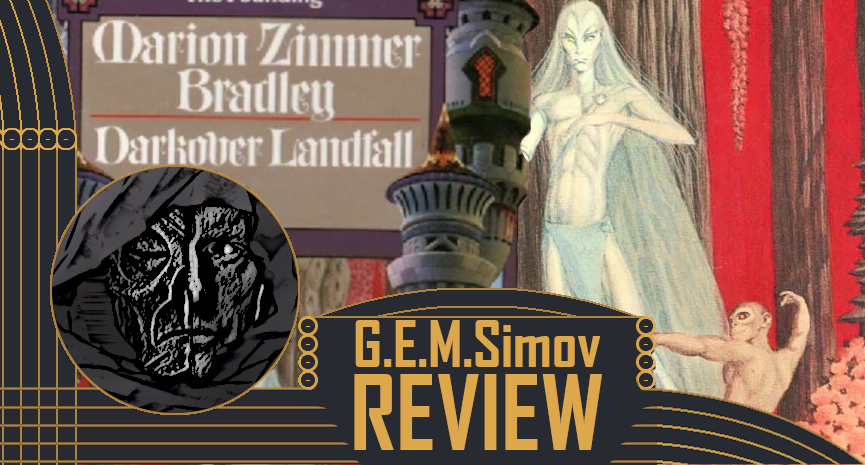
Hello everyone, I am the befuddled, even maddened, and very clearly not a telepath, G.E.M.Simov, an empath, here to tell you about a book, of which I don't know how it came into my possession, Marion Zimmer Bradley's "Darkover Landfall".
Simple review details - I rank books on an out of 10 basis, granting up to 3 points in 3 categories, as well as a last, single point from my own self, depending on my experience with it.
Content
This book, for as short as it is, features a lot, and as expected as that is of sci-fi, the manner in which it does so is also very refreshing. There is no explicit statement regarding the rightness of many of the things that are showcased in this book, nor is there explicit determination of what the answer to certain questions is. All the same, though, there are a few failures that leave me a bit baffled, when considering the rest of the stuff that will be discussed.
Right off the bat, this book asks the reader what the natural state of the human being is. Not only does it do so, but it also presents a supposition regarding the natural state of the human being which is very much in line with the Hobbesian view of mankind outside of society - a war of everyone against everyone.
What happens when every single inhibition a person has is taken away from them, with those inhibitions being artificial, be they created by the person themself or by the society they exist within, and what is left afterwards? Are the laws and rules established by society universal, and seeing as they crumble to dust when one winds up in their natural state, do they carry any weight?
Perhaps the question here is not what is the natural state of man, as that appears to be answered in a very straightforward manner, but at the same time it is not such. Some Characters, some humans, who fall under the effect of that which prompts them to lose all artificial elements to their behavior and regress into a state of natural being maintain an understanding of these artificial constructs, be they social or otherwise.
In that case, it would appear that the natural state of a human being is both affected by an unwillingness to succumb to society's rules and regulation, or maybe an inability to acknowledge them as something more than just a concept, yet at the same time showcases an ability to consider things that are tightly related with just that. There is even one Character who acts out of a desire to instill new rules of social conduct, while in a natural state, which would indicate that those things are far beyond him, at least in that moment.
But then the natural state of a human being does not necessarily equate that to a recession into the animal. The book suggests that the natural state simply features no filter that is in place, meaning that humans still maintain all their experience and accrued knowledge, but can wield it however they see fit without some great consideration of things outside of them. At the same time, that very lack of consideration for things outside of them is very equivalent to a degeneration to an animalistic state, and even then it is not all animals, for many such beings have some social codes of conduct.
The question still remains, though, and I find that a very good question, especially considering the laughable debates that keep showing up, especially regarding the "Trans Debate"(which is a reinvention of the Jewish Question, or the Black Problem, as in derogatory and discriminatory by default). The natural state of things, the natural state of humanity, is so far removed from what is currently on display that it is nearly impossible to even assume what it is, let alone use it as an argument against the self identification of another person.
Now, I feel as though this is a good enough moment for me to bring up something else - that being the downright bizarre approach that the Main Character has, or rather not his approach - his perception of women.
When he is paired up with a woman that wields power and seeks to do certain things that are more physical in nature, and would traditionally be assumed to be meant for men, the Main Character dismisses her efforts and finds them ill-fitting for a woman. There is even a moment when he expresses disapproval of specifically females in a certain profession.
The oddest thing is that there is no self condemnation on his part. He simply expresses that disapproval aimed at females, which is purely based on either bad stereotypes and sexist attitudes - and goes on with his life. It is made odd due to the fact that this is a man of science who just a page or so ago expressed remorse over the way mankind observes everything in terms of its usefulness to them, at which point he chastises himself for being hypocritical, for the object of his observation is a herd of animals, and he likes a good steak.
It is incredibly odd that he seems to hold such views which are not tempered by his own conscience. That much indicates to the reader that these views are either so ingrained in the status quo - which is of a space faring civilization that has, supposedly, solved most of their social issues - or simply correct, at least for the Main Character. However, by virtue of them being of the Main Character, there is also an inclination to consider them the right ideas, or the ideas the author wants to present as the right ones.
The heavy emphasis on asking what is and is not natural, coupled with the consideration of the natural state of man, further spiced up by this stuff, this odd view of women that is held by the Main Character, almost lends itself to an interpretation supporting the view that there are, naturally, only man and woman and that they wind up in relations with one another, and that males fight over females and whoever wins claims the prize.
It is a reductive approach to tackling the issue of the book, as reading it one gets a far better picture, leaving enough ambiguity to simply suggest that the Main Character has considerable faults, yet despite them is ultimately a good person. Still, I found those interpretations of mine bothersome, as a result of which my enjoyment of the otherwise nearly immaculate content of this book was diminished.
And it is truly impressive just how many things are considered. Is humanity meant to explore the stars and conquer other planets? Is humanity within its right to do those things, and if so, how should it go about doing those things? Whether humanity is meant to do something depends on whether the one answering believes in the presence of a creator, for no meaning can be breathed into something that happened to be at random… Though, at the same time, the book seeks to find an answer to the question of whether humanity was meant to explore other planets.
Could that be a condemnation or a consideration of the meaning found in the life of humans, or the meaning of their existence, as a result, rather than a prerequisite, rather than as a driving force? What does it mean for humanity to colonize other planets, perhaps that is the question?
It could mean many things, but most pronounced is the fact that Earth has become exhausted, be it in regards to space or resources, and so there is a need for more. And that exhaustion suggests that the ability to travel countless light years and do incredible things with technology was not coupled with the correct approach to waste disposal or matter utilization, which in turn suggests that the social state of the society on Earth is not as good as it could be.
But it could also mean something else, though I will leave that to the reader to discern.
The aforementioned question of God's existence is also brought up numerous times. Is God God of all planets, or is he only God of Earth? After all, Jesus was on Earth, and he was crucified there. And also in God's address to Adam and Eve as he banishes them, he speaks of the Earth and its creatures - perhaps, then, other planets are not meant for humanity?
And what kind of relation does God have to the natural state of mankind? It is evident, from the events that transpire in the book, that there is something artificial about the rules set by God, something arbitrary in them, something lacking enough to cause one who believes in them to disregard them when thrown into a natural state of being, or, rather, to abide by them regardless of the human beings that are involved and affected by those rules.
Yet even after that, faith remains, and faith wields great power. What is it that drives people to do things? What allows people to do things at all? The footing to act, of course, and that footing is based entirely on faith, lest one is certain they know the truths of the Universe, and none can know those (apart from God). So no matter what one believes, it is taken on faith.
And that faith comes in many shapes and sizes. The faith one has in the future can be rooted in the certainty that the answers are present in some all-knowing machine, a god of sorts, or it can be had in the ability of future generations to learn and find out everything they might need to find out about the world itself.
Yet what happens when that faith is misplaced, or perhaps if it is not genuine? That is yet another question asked by the book, and an answer is presented. The true faith that one person has is stifled and subdued in favor of the misplaced one, but when all is laid bare, it is clear.
There are so many things that are explored in a very adept manner here. Aliens, what are and what could aliens be; emotions, those of people and those that are shown, as well as those that are kept hidden; space travel and planetary colonization; hypothetical scenarios in which mankind is forced to be open with its feelings and thoughts; and so much more.
It would almost be wrong for me to go into detail and speak of each single concept that is explored or touched upon within this book, but the important thing here is that it looks at many things and does so in a very competent manner, provoking thought - as it should. Alas, that moment regarding men and women, males and females, and the attitude of the main character towards those of the other sex is just… Unnerving. 2/3
Richness of Expression
This book manages to do something. It manages to plunge me in doubt, for I can’t tell, with certainty, if the book is rich or if it is poor. On the one hand, I really want to point at it and say that this is an exquisite example of stellar expression, of perfectly twined words in a sequence of very high quality. However, on the other hand, I feel as though it is missing something.
There were moments when I was slightly impressed by the lexicon utilized by M.Z.B. There were also moments when I was not impressed by it, as those were just ordinary words found in the vocabulary of every person that speaks English, and not just that, but they were strung up in the most uninspiring manner possible. Though that’s expected - one can’t say: “he said that.” in a truly interesting way more than once in a work, right?
I would have probably had good reason to go for a Three and leave it at that, but this book does something very weird. It does not tell the reader that a song is being sung, it doesn’t do a showing of a song being sung - the process and the emotions gleaned from it. Instead, it just tells the reader the song’s text.
This would have been fine, I suppose, if the song rhymed. It would have been fine if all the songs rhymed. If there was any indication as to how they were sung, how they were performed, to sound melodic and pleasant to the ear. However, when there’s just a wall of text, and it’s formatted as a song, the reader can’t figure out how to order the words, one what to emphasize and what to draw out or not to.
You can’t sing a song out of just text, not unless you know how to sing, right? Well, with this book, there are a lot of songs. A lot of songs that are, supposedly, in Gaelic, but they’re presented in English. That takes away from the quality of the song, of course. Then, the presented English version is just a string of words with some sort of meaning, but due to the fact there’s no way of informing the reader of how to read the songs, how to hear them in their heads, the songs are wonky and wobbly.
And as a result of that, I did not really enjoy the songs. They took away from the whole of the book, as juxtaposed with the purposeful, seemingly lacking in pointlessness prose of the text, these lyrical additions were very lackluster. 2/3
Story
A colony spaceship, headed somewhere, has an emergency/crash landing. There are two factions forming right off the bat - the ship's crew and the colonists. The ship's crew is of the opinion that they will be able to fix the ship and be back on their way to their destination in a small amount of time, whereas the colonists are not so certain and want to start work on setting up a colony to make sure that, in the event the ship cannot be repaired, they do not miss the small window of opportunity to create a viable colony.
In that debacle, Rafael MacAran, a geologist, has lost his sister and is tasked with leading a small expedition to collect vital information about the unknown planet they've landed on. During that expedition, him and the folks he takes on it are taken by the Ghost Wind which makes them temporarily mad, while others yet are afflicted by the alien flora and fauna.
Not only that, but MacAran winds up falling in love with the ship's first mate, Camilla Del Rey, which could be attributed to the Ghost Wind's effect, or it could just be something that winds up happening regardless of the maddening effects of the planet's oddities.
Things go on to escalate, with the two factions making concessions with one a other and trying to deal with the effects of the planet. Sabotage, aliens, madness and rapid seasonal change are only some of the issues they need to deal with.
The story is interesting, on account of the twists and turns it takes, whilst also remaining firmly rooted in plausibility, when it comes to the actions of the Characters on a purely human level, with a pair of potential exceptions.
The plot itself is quite intriguing, though the whole of the book acts as a prerequisite, or a prequel, to an entire series of books set on the unknown planet. Regardless, I quite enjoyed it and was blindsided by some twists and turns that wound up occurring, and the stories told in the big story were very captivating, especially that forbidden love. Excuse my vagueness, I simply do not wish to spoil this pleasant read.
In addition to the plots overall competency, the story's pacing is also very crisp, perhaps on account of the shortness of the book, perhaps simply because of the fact that the author simply knew what was being done.
Overall? Great stuff. 3/3
Legendary Point
Does this book get the legendary point, so craved and wanted by all and none at the same time? Does this story, of a colony ship crashing on a fantastical, nearly magical planet, and spawning a colony on said planet while conundrums pertaining to one’s humanity rage on in the heads of the colonists, get the point?
I’ll say that yes, it does. Not only do I catch myself thinking about it long after I’ve read it, but I also think of it with a great smile on my face. The concepts that get explored within are so fantastical and truly imaginative that there was no way I could avoid acknowledging its quality. 1/1
Conclusion
8/10. A very good book, which is also a superb read, featuring ideas and asking questions that should truly be considered at length and discussed today. A great recommendation for fans of Sci-Fi and fantasy, as well as folks interested in provocative fiction that has a philosophical note to it.
I tuck it under my belt, another shining achievement that I proudly display, hoping of placing its successors alongside it.