Fallout | a Review
originally published on 13/08/2020;
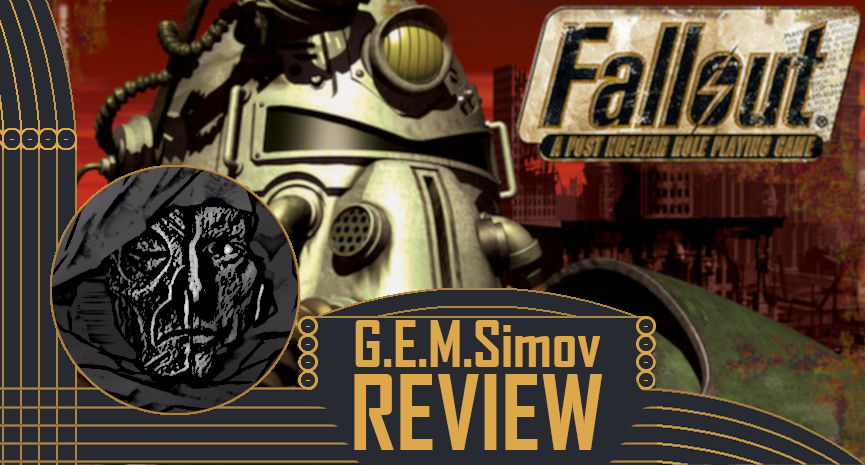
Hello everyone, I am the Vault-dwelling G.E.M.Simov, a guy who likes clean water, and today I’m talking about the dangers of Fallout: A Post Nuclear Role Playing Game (dubbed simply Fallout from this point on).
Simple review details - I rank games on an out of 10 basis, granting up to 3 points in 3 categories, as well as a last, single point from my own self, depending on my experience with it. Also, I am a gameplay designer and a writer so I got the credentials to talk shit.
GAMEPLAY
Fallout is a top down, isometric roleplaying game from a few years ago. It is played, almost entirely, through the use of the mouse, although there are some hotkeys that can be utilized for max efficiency… Even if efficiency is achieved by other means.
The game makes use of chance as a defining factor for how situations are resolved, but that does not truly get in the way of enjoyment derived from it. In fact, although chance seemingly affects all interactions the player has with the world of Fallout, it is not so. Chance affects the outcomes of situations, but is not the end-all be-all of the solution. A situation that was going to go badly for the player has an incredibly small chance of going well for them, and the other variables are based on how badly the situation will go - it could be nasty, or it could be horrible.
Chance in Fallout seems to be an additive, rather than a multiplicative. There is a chance that one might critically strike in combat and kill an enemy in one hit… But that wouldn’t really change the outcome of the fight, as a critical strike generally deals only twice the damage, so it would be 2 hits at the price of 1. There is a chance one might pick a lock at their first attempt, but they are bound to succeed after three or four attempts.
Of course, some mechanics are affected by chance at a greater rate than others, but the fact of the matter is that chance does not appear to be as prevalent as one might think it were, initially. That makes the allocation of Skill Points and Stat Points actually mean something.
Yes, ladies and gentlemen, a roleplaying game has both Skill Points and Stat Points. One would have thought that these did not actually exist, for many a game claiming to be roleplaying games in current times are lacking some of these.
At the start of the game the player has a number of points to allocate to their Stats, making their character unique, in the sense that these Stats are not going to be increased by more than 2, even if the player did everything in their power to do so. That means there is a very defining, important decision to be made, right at the start of the game, because these Stats define how easy it is for one’s character to do everything.
The character will be better at doing some things than doing others. That makes the character appear somewhat grounded in reality. As in, ladies and gentlemen, the character might even have a flaw! Imagine that, a character who is not the most amazing thing to have ever existed! And having flaws makes characters interesting, even if they have no history of their own, for their failings become a juxtaposition for their successes, and the game becomes more entertaining.
Of course, it is fun to always kill the enemy in one hit. But that does not make for something memorable or exciting. What about a situation, in which one’s character is not all that good at shooting with a gun, but has to do it either way, and ends up shooting their friend dead? What happens if this can also happen to enemies? The game becomes fun. Exciting. The player does not know how everything will go, as the additive of chance makes encounters and situations end differently, thus creating an interesting environment to explore. Game’s a pair of decades old, by the way.
Skill Points are the way to specialize in doing certain things. There is a limited amount of Skill Points the player can obtain in their play-through, but that is not truly relevant, as many players will not reach the max level. The fact that there is a limited amount of Skill Points makes it so that the character, who is already interesting and unique as a result of what their Stats are, can become even more unique, and, as a result of that, interesting, by specializing in the doing of certain things.
A character who is agile can decide to specialize in sneaking, or lock-picking, or picking pockets, or combat. A character who is intelligent can specialize in hacking, or medicine, or repairing, or combat. A character who is charismatic can--
The idea that there are different options, allowing for the creation of different characters, is a very well executed mechanic. If anything, the experience of Fallout is, in part, founded upon exactly this.
Now, combat has been mentioned once or twice, and it should be concentrated on for a moment. Fallout’s maps are divided into hexes. There is a large hex grid, and then there’s the map. The hex grid is, normally, not visible, but, when combat begins, and the player wants to move, it becomes visible. That hex grid would not be used in such a manner, unless the combat for Fallout was turn based. And that it is.
Fallout’s combat is a little drab, however it is made interesting by these opportunities for spectacular failure, as well as the chance at an incredibly bloody demise for either the player or their enemies. The player has a number of Action Points, and every thing the player might want to do requires a certain amount of Action Points. Agility increases the amount of Action Points the player has. Typically, the player can do two things before ending their turn and allowing other characters (be they friend, foe or neither) to have their own turns.
The AI in Fallout is sufficiently advanced, meaning the way combat works is simple enough that the AI needn’t be smart at all, and so it always poses a threat, but is never too overwhelming, unless the player makes a mistake and engages in a fight they should have attempted to avoid. It should be noted that a combat focused character can engage in any fight they want and end up overcoming the challenge, even if it was a very overwhelming encounter.
However, the AI in Fallout is also ridiculously stupid, sometimes. The player can have allies, but these allies are actually only made to not think of the player as a target. Thus, the allies might situate themselves behind the player and shoot right through them at an enemy. That is all well and good, but then said ally might be a bad shot and might end up shredding the player into a special, 30 year old blend of human cheese.
But is that all there is to Fallout? A little bit of combat and some stats and skills? No, of course not. Fallout is a vast wasteland that has the player running from place to place, exploring this world that has been destroyed by man’s greed. And man’s greed has outlived many men, and still outlives it. The player can gamble, the player can take on assassination contracts, the player can steal, the player can buy and sell, the player can do many, many things.
Fallout is such a game, such a GAME, that it allows the player to do almost anything, except, maybe, engage in the satiation of carnal desires and start a family. Most of the game is spent either running about, looking through the map in search of things, or talking to people.
Talking to people falls into the Story category, so it is not that easy to talk about here, although it should be noted that the game is aware of the player, their accomplishments, their belongings and their Stats. In conversation, some options might not even exist for the player, if they have done something in the past, if they have not done something, if they have something in their inventory or if they do not have something in their inventory, and so on. That means gameplay influences the story itself. How cool is that?
Fallout’s UI is big, described by some as clunky, and is very very dated. It is, however, very functional and does not need the overly simplified, streamlined murder of unique UI that many modern games engage in. Everything the player might need can be easily discovered through the click of a few buttons, and these buttons are all labeled. Nothing is out of the player’s reach through the UI, and the player can access anything they want or need through it. There is no staggering introduction of new menus, everything is there and at the player’s disposal.
The fact of the matter is that Fallout was made in a time when games were still made for a computer, unlike current times when games are made for… Well, not a computer, but another type of computer that happens to have another name. That meant that the use of the mouse, and the clicking through menus that have an incredible number of options, was not an issue back then. It still is not, but if one is used to having three or four button prompts on screen at a time, they will end up overwhelmed by the ‘apparent’ complexity of Fallout.
Alas, Fallout is not as complex as it might appear. It is intricately crafted and does offer a measure of depth that many other games do not even try to present, but it finds itself lacking. Some things cannot be accessed by characters with certain Stats, but then the outcome of the game, the good one, at least, is mostly the same. The fact that some things cannot be done during one play-through makes the player consider playing again, but as they play through the game again, they end up finding themselves at a loss of wonder.
Fallout excels at its first play-through. The player explores a new world and solves a great mystery, but there remain a few things that the player could not do due to their Stats. And so, the player might indeed replay the game, but it will be the same old thing. These few new things the player might discover, when playing with a different array of Stats, is not worth the venture through a world already known, a story already experienced.
A game that is close to 25 years old, but has so much good in it that it still dwarfs the biggest games of modern gaming, is bound to be good, and to have something stellar to itself. Alas, its age is also prone to making it find itself stumbling through territories that were not nearly as well charted as they are now. 2/3
PRESENTATION
Fallout is a game about a world that is so vastly different from what humanity is used to that it is, essentially, a brand new world. How, then, does Fallout bring that world to life?
Through the use of intricately designed “Talking Heads”, which appear so unique and ugly that their hideousness becomes beautiful. It is not the uncanny valley, but some conversations feature these Talking Heads, and the faces of these characters become remembered by the player, as they are not only incredibly well crafted, having been fully made in real life so as to be of the highest possible quality, but also granted the gift of voice acting.
A game like Fallout, a roleplaying game of such magnitude, either has no voice acting or very little of it, and it is not even good. However, Fallout, in all its glory, has voice acting for EVERY important character… And the voice acting is spectacular. The actors have all done an amazing job bringing these people to life, and even if some sound strange or uncanny, they still fit in this bizarre world that has come about after a nuclear apocalypse.
But it is not only Talking Heads that look good. The world itself, having been granted a detailed and rich coat of muted colors, still retains an appearance that makes one think of how well crafted it is, even after all those years. The work put into the creation of the unique visuals, which fit so well with the setting, has, no doubt, been a great effort, and it shows.
What, then, can one say about the SOUND of Fallout? Well, one only needs to listen to a single piece of the soundtrack, and they will find themselves IN this dying, almost wholly dead, world. The music by Mark Morgan is stupefying, and borders on genius in its quality.
The sound effects are a little unbalanced in their fidelity, some are too loud, others are a bit quiet, some sound strange, others sound just right. A mixed bag, but it does not truly detract from the overall magnificence of this game’s presentation. 3/3
STORY
Fallout is the best story to have ever been set in any game with a post-apocalyptic setting. For a moment, I considered saying any work of fiction, but then the scale becomes a tad too large, and perhaps I’ve yet to find something even greater, thus it is, definitively, the best story to have ever been told in a game with such a setting.
The manner in which the world is crafted, the detail invested into it, the overall lore, the themes, the execution of Fallout is incredible. The Talking Heads give life to characters who are so well written that one might find themselves empathizing with even the most monstrous of creatures.
At the root of it, Fallout is a giant Fetch Quest. The player’s character is sent out of their home, being the first to leave in a hundred years, to find a water chip that manages the purification of the life-giving liquid. The player sets out, knowing nothing of the outside world, and quite ill prepared to face it. And then one large quest begins - wandering through the dead land in search of salvation for a people, exploring new destinations, seeing different people’s solutions to life in the wastes - it all merges into a painting of exquisite quality.
However, that all pales in comparison to what comes next. The second part of Fallout deals in humanity. Its merits, its faults. Fallout asks what is right - and is what is seen as good truly good and right, or is it wrong, albeit good? Are good intentions, and the obvious good of the actions coming as a result of them, supposed to be allowed to pass, if they trample the will of others? Is the loss of something that makes humans what they are something that can be afforded for a better chance at survival in this vicious world?
The number of questions posed through the story of Fallout, both its first and second acts, is staggering. So many answers to be sought by the player, be it by themselves, or in books and other mediums. So much thinking to be done, so much to ponder. All done through the lens of a fantastic game that left all who experienced it wanting more. 3/3
LEGENDARY POINT
Does this game get the legendary point, so craved and wanted by all and none at the same time? Does this masterpiece, does this MONOLITH of gaming history warrant a legendary point? Yes, of course it does.
How could I not give Fallout the legendary point? How could I not give this experience my vote of approval, when I have spent days thinking about what this game has presented me with? How can I allow myself to even consider giving this game anything, safe for a spectacularly high score? Fallout is a game I wish I could say has changed my life, but, alas, it did not. It did, however, help me reaffirm my perception of the world and my beliefs - something many might say games should not be doing.
But who says that? Fools who believe themselves aware? Mongrels who consider this form of art to not actually be what it is? Video games, having become a lucrative market, are being pulled away from their true nature by money-hungry companies and executives, but it is known to those who see and who can appreciate it. Video games are art, as much as movies and literature and paintings and music, for they contain it all within themselves.
A game can be a mighty way to urge one to think. And that is a function of art. 1/1
CONCLUSION
9/10. Fallout is a game that should be played by every single person who plays video games, and is an experience that should be experienced by every single person that enjoys gaming. In fact, it is so great, I’d say it would not be bad at all to have it be experienced by all of humanity. Might make them reconsider their course of action. An exquisite piece of art, this is one of the best games out there.
I tuck it under my belt, another shining achievement that I proudly display, its vibrance so blinding I only procure it on special occasions so as to show others a fruit of great labor and love.