Five Nights at Freddy’s | a Review
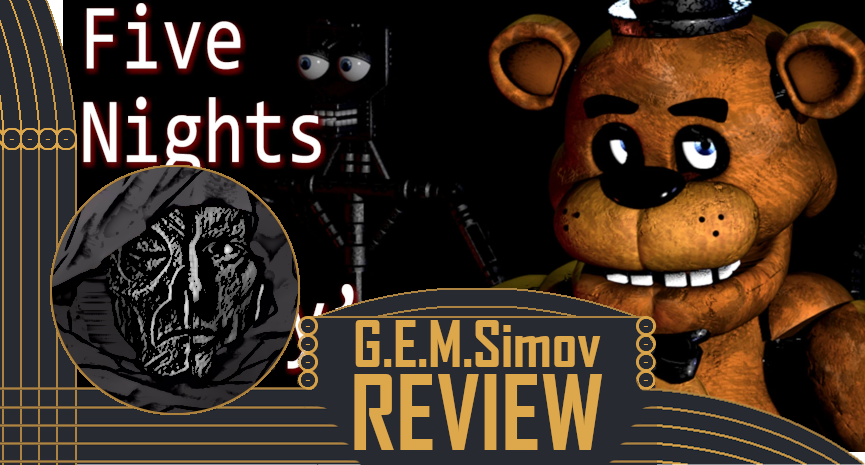
originally published on 13/12/2024;
Hello everyone, I am the bite of 87, G.E.M.Simov, a staunch critic of animatronic animals, and I have come to tell you all about “Five Nights at Freddy’s”.
Simple review details - I rank games on an out of 10 basis, granting up to 3 points in 3 categories, as well as a last, single point from my own self, depending on my experience with it.
Gameplay
Five Nights at Freddy’s (henceforth FNaF) is a horror game that wound up accruing ludicrous popularity. However, it might be difficult to gage why it is that the game wound up being as popular as it got.
FNaF features 0 configuration or customization of the experience, with there being so little in the way of input that the Player can only continue a game or start a new game. If the Player presses the Escape key at any point, the game just closes completely. The issues that arise from this are more related to Presentation than to Gameplay, but the fact that there is no pause screen is a bit annoying.
So, in FNaF the Player Character (PC) is seated in a room, framed by two doors, provided with a tablet on which they can check a number of security camera feeds. The goal is to make it til 6 AM.
Naturally, making it till 6 AM is a bit problematic, due to the fact that there are enemies in the game. There are 4 of them, 3 starting off in the same room, and thus being visible, at least initially, in the same security camera feed, and the fourth starting off in another room, visible in a different security camera feed.
These 4 enemies will start walking around, their mobility trackable, loosely, via the different security camera feeds. If they start getting too close to the PC’s location, they might burst in and “kill” the PC, bringing about a game-over screen via a very cheap jump-scare. To avoid that, the Player can close the doors until the enemies wander off elsewhere.
However, there is a resource in play that makes it difficult to just do that. The Player is given a certain amount of power at the start of a night, 100%, and that value goes down as time passes. The rate at which power is consumed increases based on the number of things that are being used - bringing a door down and keeping it closed consumes power, looking at the security camera feeds consumes power, turning the lights in the corridor framing the close-able doors also consumes power.
Thus, simply closing the doors and waiting it out is not going to be doable - because the Player will run out of power and will experience a blackout. When a blackout occurs - and it keeps going - the Player will be forced to experience complete darkness and an absolute lack of agency, at which point one of the enemies will show up and play a little ditty over the course of a few seconds, and then will kill the PC via a jumpscare.
Conveniently, if the clock hits 6 am while the ditty is playing, the Player will get to survive the night. However, it is best not to push one’s luck.
So, that’s the game. The Player is given an “area” to overlook via security cameras, there are 4 miscreants running around the area. If the goons start getting close to the PC’s location, the Player might need to close one of the doors leading into said location, or they might need to check the corridors with the lights, as there are far too many blind-spots on the security camera feeds.
The ultimate goal of the Player is to make it through all the nights (5 of them). Then there’s also the opportunity to play through a 6th night, which is a challenge. Completing the 6th night allows the Player to play a Custom night, which allows the Player to set the AI level (difficulty) of each enemy, allowing for an additional, even more challenging experience.
Each night lasts around 9 minutes, and each night is more difficult than the last, on account of the fact that the enemies become more and more active. As an example, on the first night the only enemies who are actually active are Bonnie and Chika, while on the second night another enemy is also active - that being Foxy. In addition to that, how active an enemy is determines how often they move around.
With that said, that’s pretty much all there is to the game. The Player moves their mouse cursor around, clicks buttons and tries to make decisions with what limited information they have. There are, of course, mechanics that are not explicitly stated but are in play - such as the fact that turning on the lights in the corridors every now and again dissuades some of the enemies from approaching, or that looking at certain enemies via the cameras makes it less likely for them to move.
Overall, the game manages to create a situation in which the Player is as active as possible, though not in a haphazard manner. One of the better ways of going about playing the game involves setting on a short timeframe in which the Player does nothing and just waits, typically between 6 and 10 seconds, and then checks the cameras and illuminates the corridors, after which the Player goes back to waiting.
A rhythm of sorts needs to be developed and adhered to. Even though that’s a factor, the most important part of the game, and the most impactful aspect of it, is that it provides the Player with as little information as possible. In fact, the amount of information the Player has is so tiny that there’s a huge amount of guessing that goes into making the decisions the Player makes and that affects the way they approach the game.
That, coupled with the fact that the game is designed in this clunky, for the Player, manner that cuts off swathes of 5 or more minutes of gameplay when the Player dies, as well as the fact that the Player is actively punished in an additional manner whenever that occurs (via a jumpscare), does do its job at incentivizing the Player to not make mistakes and to want to not die.
Even so, the game is definitely clunky in its design. The fact that it features no pause screen, nor the opportunity to pause for a moment between nights, leads to it, essentially, being a brutal, hour-long gauntlet that might have adverse effects on the Player’s health, or at the very least will get them fatigued in an unpleasant manner.
There is no room for a sigh of relief, and that does contribute to the feeling the game goes for, but it is not a pleasant one, especially considering the fact that the game’s intensity comes out of a resounding lack of knowledge - be it due to not knowing enough or due to being unable to know enough, for enemy movement depends on RNG.
FNaF is a game that does a number of things correctly, but overall leaves an unsatisfying feeling. It’s not the game that one comes to enjoy, it’s not the moment-to-moment gameplay that draws the Player in, it’s the thrill, it’s the experience. Naturally, this is associated with the game’s Presentation, not its gameplay, as a result of which it turns out FNaF does as much as it needs to and only that. 1/3
Presentation
This is not a beautiful game, nor is it pleasant to look at. It is also not a very endearing experience overall, and its sound is unnerving, nothing more. However, there is a captivating element to that - the macabre, if it can be so called, or perhaps the uncanny.
Almost everything in FNaF is presented through a filter that adds a layer of charm to it, and then that, which is not filtered, is accompanied by something else that makes the viewing of it more intense - be it a lack of light or a loud pang, there is something that heightens the experience of every moment.
Even simply looking at the security guard’s office is such a heightened experience. It is not heightened purely by its appearance, but in combination with the context those two elevate each other to new heights. The droning, quiet sound of the lights buzzing and the fan whirring are so subdued by comparison to the loud scream or gasp that sounds whenever an enemy appears or attacks that they are already known to be the layers of a foundation upon which the jump-scares can do their thing.
The darkness beyond the windows and doors of that security guard’s office is filled with the unknown, but also with the knowledge therein hide enemies who are going to startle the Player, who are going to cause the Player displeasure and even harm, in a sense.
And yet all that works. It melts together into a phenomenal execution of the concept that the developer had in mind, and it does exactly what it needs to do. There is no music, only ambience, which ambience is not something enjoyable, but it is good in the sense that it does its job phenomenally. The entirety of FNaF is geared towards being a horror game, and it shows.
Is it a good horror game? Is it a good type of horror? No and no, but it does what it has set out to do perfectly, it is the exact type of cheap, garbage startling that comes after a build-up of tension that scary movies and scary games desire to do, and FNaF does it almost immaculately.
There might be no tutorial, it might be loud as all hell (and there is no option to lower the volume), but it is intentional and it works. 3/3
Story
FNaF presents a humongous number of questions and then leaves the Player in a puddle of tears and drool. In FNaF, the Player takes on the role of some schmuck who is working as a security guard for Freddy Fazbear’s Pizza, who makes it through an entire work-week of being at a hair’s length away from being stuffed inside an animatronic suit, that’ll turn him into mincemeat, by unnervingly intelligent animatronics who roam around the pizzeria at night.
The questions that show up are all related to how and why are things going on, as well as what were the events that led up to them. In addition to that, there are other questions - why is there a dark room, why is there a 5th enemy that bends reality, why?
It is a pleasant sort of mystery that winds up presenting itself, but there is too little for the Player to be able to solve it. In addition to that, the fact that the game has wound up receiving a billion sequels, all of which are swirling about the mysteries of this first game, indicates that its lore, its world were just happenings, or that it is not meant to be a finished standalone tale, which is a shame.
Regardless, there is a lot of interesting stuff, and yet that interesting stuff is either only hinted at or is not elaborated upon in a healthy fashion. The Player Character makes it out alive, 120$ richer, and the mysteries are all left up in the air - or up to the money the Player will spend buying the sequels.
So, what’s there to be had? There’s an incredibly rudimentary story - guy works night shift 5 nights in a row and gets paid - but there’s a pretty interesting setting in which that rudimentary story takes place. The issue of it being 95% mysteries and 5% pseudo answers is not totally problematic, as horror stories tend to require some kind of inexplicability, but there’s just too much here. And then the addition of the “real story” understandability being dependent on reading through peripheral material and playing a silly number of sequels is… Not that good. 2/3
Legendary Point
Does this game get the legendary point, so craved and wanted by all and none at the same time? NO, no. There is no horror game that I will give the Legendary Point to, so long as it depends on cheap jumpscares. I desire dread and true fear, not a funky little startle coupled with loud music that makes my lizard brain go! I also want a more explicit presentation of the things that I am witnessing… So FNaF does not get it. 0/1
Conclusion
6/10. Markedly high for what it is, FNaF is a horror game that manages to do one thing very right. As a result of that, I would gladly recommend it to seekers of cheap thrills and no one else.
However, it goes into the bag of mediocrity, to gather its unimpressive dust and retain its inexplicable grasp on popular culture.