Kingdom: Classic | a Review
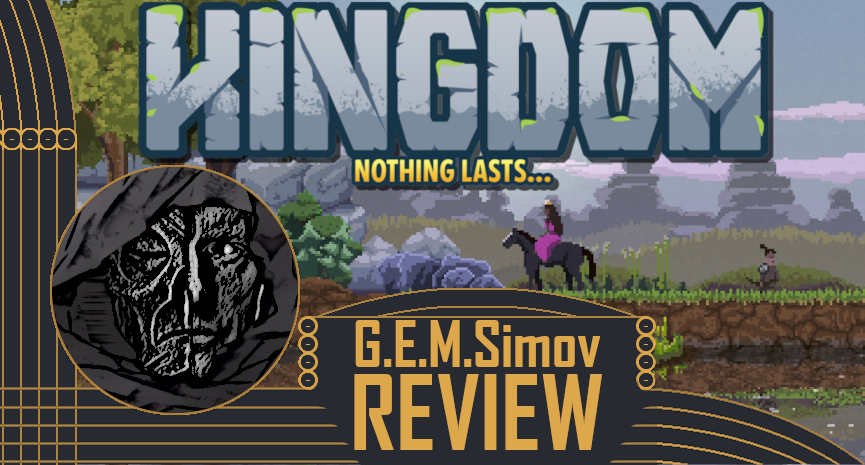
originally published on 13/12/2024;
Hello everyone, I am the monarch, G.E.M.Simov, a ruler of men (as in mankind) so wise and benevolent that I was mourned for months on end after I was deposed by greedy, corporate CEOs. With no occupation, I have come to tell you about “Kingdom: Classic”.
Simple review details - I rank games on an out of 10 basis, granting up to 3 points in 3 categories, as well as a last, single point from my own self, depending on my experience with it.
Gameplay
Kingdom: Classic (henceforth KC) is a 2D side scrolling game that features empire management of a relatively rudimentary level.
The Player takes control of a Monarch that is either a King or a Queen, which is randomly determined and has no bearing on the gameplay. The Player is then provided with a number of things they can do. They can walk around with either the A and D keys or the Left and Right arrow keys (to go left or right). They can hold down the Shift key to go faster, but they have a limit on how long they can do that, because the horse they constantly ride will tire out and need to rest up.
Here’s a funky mechanic - if there is grass on the spot where the Player Character (PC) stops, the horse will munch some green and recover a lot more swiftly than it would otherwise. Now, those are all the mobility related things that the Player can do. The last thing in their repertoire is the dropping of coins, which happens by pressing the Down arrow key or the S key.
Everything happens with coins in KC, and so dropping a coin (or two or three) is essentially pressing the interact button. So, what’s the deal with coins? What does one use them for? Where does one get them from?
At first, the Player does not have a reliable source of income, with a bunch of coins being strewn around right in front of the center of the game world. By picking those coins up, the Player is then urged to use them in a manner that will ensure that more coins will be produced.
So, let me just present the number of things that can be done with coins - they can be dropped to the many vagrants who are aimlessly sitting at camps in the woods, which will turn the vagrants into peasants or, rather, subjects of the Monarch, which will prompt them to travel to the center of the map. Coins can also be used whenever an indicator shows up over an object the PC is close to - that indicator is made up of a number of circles, equal in number to the quantity of coins required for the interaction to occur.
The most important one of those is the campfire - which is situated at the very center of the map and serves as the heart of the Kingdom the PC is establishing. Any subjects will stay close to the campfire, especially if they have nothing to do, and those that do have something to do will return to the campfire at night.
The campfire is also one of the Player’s means of advancing through the game. By giving the campfire coins, the Player upgrades it (and by extension the Kingdom), unlocking new tiers of upgrades for the buildings that can be upgraded and new uses for coins. In addition to that, the higher the upgrade level of the campfire, the more money the Tax Chest provides (up to a certain point).
The Tax Chest is the most reliable method of obtaining money in KC. Every morning it will show up and will be openable, containing anywhere between 1 and 7 coins. Oddly enough, it contains 1 coin at the highest upgrade level and 4 at the penultimate, while the highest possible quantity can be obtained from the 4th upgrade level - 7.
Let’s not linger on that (even if it is a strange design choice) and instead go on to explore the day and night cycle. The progression of the Player in KC is measured not just by the upgrade level of their campfire, but also by the day it is. Naturally, the Player starts off on day 1, and can go on almost indefinitely, although there is a limit to just how indefinite that is.
That’s owed up to the fact that at night enemies attack. They come out of their portals, dotted around the valley, and from the very edges of the map, and attack. If they touch a subject of the Monarch, they will knock out the coin given to the subject, turning it back into a vagrant. That coin might fall into the river and disappear forever or it might fall onto the ground, becoming collectible - however the enemy is almost certainly going to grab it and make off like a bandit.
A similar thing happens whenever the PC is touched by an enemy - they will lose one coin, which will either drop down to the ground or fall into the water in the foreground. When the Player runs out of coins, however, the PC’s Crown will fall off if they are touched by an enemy. The Crown never falls in the water, instead falling on the ground. However, if an enemy touches the Crown, they will steal it, which means that the game is over.
Thus coins are not only a currency and an upgrade material, but also health. The more coins the Player has, the more difficult it is for the PC to have the Crown stolen. That works initially, as the only type of enemy that shows up at night for the first few nights, are little ones who actually steal coins. Whenever one of them gets its hands on a coin, it will run away and never return.
In truth, the Player can just drop a coin and allow the enemy to take it, instead of risking the coin falling into the water when it gets knocked out of them via a touch from the enemy. However, with each passing night, more and more enemies attack… And there are also new enemy types that show up, ones that are not content with just coins.
To deal with those, the Player has two options (though it is largely one) and that is to arm their subjects. Upon finishing the tutorial (upgrading their fire for the first time) the Player gets the opportunity to buy Bows and Hammers. Bows cost 2 coins, Hammers cost 3.
Whenever a Bow or a Hammer is purchased, it will be set down at that station - allowing for up to 4 bows and 4 hammers to be purchased but uncollected. Whenever a bow or a hammer is purchased, one of the Monarch’s subjects, who is not doing anything, will rush towards the spot where either the bow or the hammer is and collect it.
By collecting the item, that subject will become either a worker or an archer. Workers are needed to build structures - such as Walls or Towers - while archers are needed to kill the enemies. However, there are more uses to both.
Workers can cut down trees, which expands the area accessible for the archers and also allows for more buildings to be constructed. In addition to that, they can upgrade or repair damaged buildings.
Archers, on the other hand, will run around their accessible area and shoot at any rabbits or deer they see (during the day). Whenever a rabbit or a deer is killed, it will drop coins, which the archers collect and, upon being passed by, or stopped next to, by the Monarch, they will drop those coins. At night, the archers rush over to the nearest wall or, if there is none, will walk up to the vicinity of the fire. It is important to note that every other archer positions himself on the other side of the fire.
That means that to effectively protect the Kingdom, the Player needs an even number of archers, who will be split in two and half will go to the Left, half will go to the Right.
There are two other types of units that can be created, but they come up in the later stages of the game. One of them is the farmer, who needs to collect a hoe, and then there also needs to be a stream that has been built upon by a worker. Then, the farmers will go to that spot, which is now a farm, and will stay there indefinitely, even at night. However, they will produce massive amounts of coins.
The last other unit type is the Knight. The Player can only have 4 of those, 2 per side 2 going left and 2 going right. Knights are the reliable means of ending the game, because they will travel to the furthest wall in their direction and will stand slightly outside of it, underneath a flag that appears. If the Player walks up to the flag and deposits the required number of coins, the Knights will lead an attack alongside a number of archers.
What is the attack being led on? The nearest portal. The Player wins the game by destroying all portals and surviving the retaliatory waves - because after a portal is destroyed, the enemies will launch a special counter-attack wave that is a lot stronger than the ordinary nightly waves. Naturally, when the last portal is destroyed, the final wave is incredibly difficult to deal with - or, rather, incredibly time-consuming.
Fortunately, it is manageable, but this almost all there is to the game. Around the world - be it to the left or to the right - the Player can find a number of special structures. 1 Worker shrine, which can be given coins up to 3 times and appears to improve the solidity of walls. 1 Archer shrine, which can be given coins up to 3 times and seems to make archers do more damage. 1 wooden shrine that, when given coins, becomes stone, and apparently unlocks stone upgrades (when the proper upgrade level for the fire is reached). There are also 2 chests with coins in them, as well as a black horse that can be gotten in exchange for 3 coins, who gets tired a lot slower than the default horse.
Lastly, it must be noted that nothing can just be built. It needs to have a prerequisite spot to be built upon - farms need a stream, walls need a small dirt hill and towers need a stone formation. Unfortunately, the way it works is that for any of those 3 to be accessible, the woods surrounding it need to have been cut down.
However, the AI responsible for the workers is esoteric at best - there are instances of 4 or more workers sitting around the center of the map while a number of work orders have been queued, half of them being to clean up woods. Then there’s the fact that the forest must be cleared more thoroughly than just up to the object the Player wants to build on, which often coincides with such an instance of workers deciding to not do anything.
In fact, this is not an issue with just the workers. All the units not controlled by the Player and not hostile are very stupid and sometimes fail to work. The deer are programmed to run in the opposite direction of the PC, and the Player can use that to corral them into the arrows of their archers, however sometimes the deer will just decide to run towards the Player, even if it had been running away from them up until now.
Then there are suicidal workers who rush off to actually attempt to complete tasks at night, running right into the enemies and getting turned into vagrants. Another funky thing would be the Archers who, when they notice there is an empty tower, will run towards it at all cost, ignoring any enemies in between them and the tower.
Farmers get killed very often, on account of them living at the farms, but that’s expected. Oddly enough, there is no great issue with knights, though the amount of headaches that workers not working will cause the Player is more than enough by itself.
Lastly, there is a very unfortunate thing - and that is the fact that the game cannot be continued after the last portal is destroyed, even though an infinite mode as a continuation of the ordinary mode would have been totally doable, seeing as enemies already do spawn from the edges of the map. Alas, it is not so.
Overall, though, KC is a fantastic gameplay experience, featuring some very neat tricks that can be performed on the regular and allowing for a very real fantasy of “building up an army” and “managing a kingdom so well that it flourishes” to blossom. Even with its issues, it is still more than a little decent. 2/3
Presentation
KC is staggeringly beautiful. I mean– It’s got me salivating at the thought of it– I mean…
Yeah, that’s what I wanted to actually say. Kingdom: Classic is gorgeous. It might be a relatively simple 2D sidescroller that features one same-y, big pixel-based level, but it is so unbelievably well done that I’ve literally nothing I can say to detract from its quality.
There are three layers for the eyes of the observer - the background, the foreground and between them the ground. The background is least reactive of all the grounds, as it is the background, but it also has the opportunity to be the most detailed, due to the fact that it is literally the background. It allows for great vistas and picturesque sights to unveil themselves before the Player, whilst also serving as a means of displaying the time of day.
The foreground is the second most reactive ground, due to the fact that it is composed of water that reflects, loosely, what is happening on the ground. That foreground is part of the reason why KC looks as good as it does - for it it was limited to only the ground and the background, it would be missing that extra bit of wonder that makes it so incredible.
Lastly, there’s the ground, which is where all the Gameplay takes place. Not only does it feature all the Character sprites - be it the Player Character, the Villagers, the Enemies or the Animals, who are all lovely to behold - but it also features structures and objects. One of the most entertaining and captivating things to look at when it comes to KC are the buildings, especially in regard to comparing them following an upgrade.
The music and sound effects do not let up, though. They keep up the pace of the visuals and are a joy to hear. All the musical tracks that can be encountered over the course of a game of KC are serene and peaceful or dark and suspenseful, yet they are so well picked, or perhaps composed, for the game that it matters not.
The sound effects are similarly wondrous, especially when it comes to the menu, for every time the Player moves their mouse’s cursor over one of the options in the menu, the game awards them with a little xylophone-esque plip, with each subsequent hover playing a different plip, allowing for a quaint little melody to take root.
The same applies for filling up a money bar with coins - each coin added produces a different chime, and the chimes are very pleasant for the ear. In regards to actual sound effects, they are not loud and bombastic, appearing more subdued, yet they are satisfying and very well placed. The sound engineering, if that can be said, is superbly done in KC.
Then there’s also the manner of animations - not only does the smoothness of the game get used in a very clever way - for it runs at 60 frames per second, yet that smoothness is only utilized for the reflections of the water in the foreground and the rain, as well as the coins (and the coin bag), while everything else is purposefully kept at a lower framerate, as a stylistic choice.
It somehow works and makes everything look more picture-esque. KC also utilizes screen shake very cleverly, only for important moments, as well as slow motion, to emphasize the severity of said moments.
To top it all off, the game has a very good tutorial that tells the Player almost everything they need to know. Not only that, but it features a very diegetic User Interface, with the exception of the circles that show up to indicate that money can be used to do something with a certain object and the bag of coins the Player has. Everything else is diegetic, and for KC this is a wonderful thing.
As I already said Kingdom: Classic has phenomenal Presentation. 3/3
Story
KC has a story, but it is very loosely conveyed - almost exclusively through environmental storytelling and a single line of text at the very start of the game. There was, once, a great kingdom that spanned the entirety of the land (which is a valley of some sort, with impassably steep stone slopes framing it), though that kingdom fell to ruin.
It is likely that the kingdom was brought down by the enemies - who come from another world and steal everything valuable, taking all one has until they finally steal away the crown of the monarch. And, without a crown, there is no king nor queen.
So this kingdom’s people become vagrants and despair, until one day the Player’s Character, a King or Queen who has a crown on their head, arrives. That new monarch needs to spread prosperity through the land while protecting both the crown and the people, until they are strong enough to fight back and destroy the enemy’s portals, rendering the kingdom safe.
All of this is not told to the Player - with the exception that a new monarch will attempt to not fail where the last did and that without a crown there is no monarch. Everything else is conveyed through Gameplay and through the world itself, and it is done so masterfully that I find it hard not to gush about it.
It allows for a measure of discovery that depends, or at least tricks the Player into thinking that it depends, on the Player’s own wits to be performed. Not only that, but it lends itself immaculately to emergent storytelling, allowing for a vast multitude of stories to be devised and told thanks to the way this game works.
Alas, it is too little. There are ruins dotted around, there are altars here and there, but nothing brings a sufficient amount of information. Are the shrines dedicated to Gods, or are they statues that celebrate the importance of workers and soldiers? Is the wooden building related to anything, or is it just there as a means of getting an upgrade?
Many questions show up and, of course, they lend themselves to emergent storytelling… But it seems as though there's a need for more. 2/3
Legendary Point
Does this game get the legendary point, so craved and wanted by all and none at the same time? Excuse my french, but I will say that you, dear reader, are damn right to be asking this question, and you are damn right that KC gets the Legendary Point. This game is so incredibly atmospheric and cozy that I am unable to not give it the point purely off of that.
This kind of visual appearance is timeless and is truly beautiful - quite unlike the games that try to replicate realism and become old and dated within a year of their release. KC’s style is eternally youthful, but what makes it even better is that it also has a fantastic concept that is very well executed.
The sheer idea of empire management through the lens of an actual person is magnificent, and has yet to be done many enough times (Mount and Blade is not enough), nor has it been done as splendidly as it has been done here (you know what I speak of, dear reader). Naturally, the fact that this treasure was the result of 3 people’s work is staggering, and that also pours flammable oil into the flame that’s already burning. YES, KC gets the Legendary Point! 1/1
Conclusion
8/10. Kingdom: Classic is a brilliant example of why indie games are the heart and soul of gaming. I recommend this game to absolutely everyone, purely because of the audio-visual experience it provides. For fans of empire or city management games I’d argue it’s a very good choice, and it might have something for fans of other types of strategy games.
I tuck it under my belt, another shining achievement that I proudly display. Fortunately, this king has his crown!