Kirikou and the Sorceress (1998) | a Review
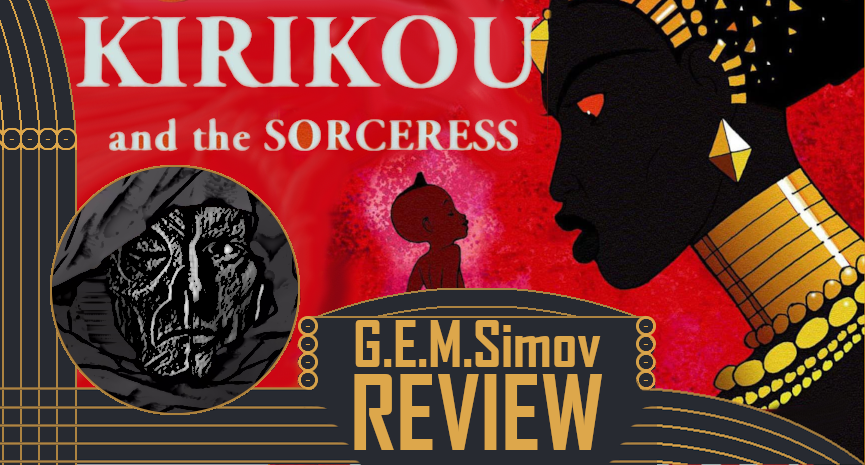
originally published on 13/12/2022;
Hello everyone, I am the not-so-tiny G.E.M.Simov, a once small but always brave young lad. Today, I’m experiencing a humongous blast from the past in the form of a fantastical story from down South - actually not quite, but almost - it’s Kirikou and the Sorceress, and I’ll be telling you all about it!
Simple review details - I rank movies on an out of 10 basis, granting up to 3 points in 3 categories, as well as a last, single point from my own self, depending on my experience with it.
A disclaimer - the terms 'movie' and 'film' will be used interchangeably in this review.
Presentation
This is an animated movie, as a result of which my grading on presentation is going to be a bit different from what I normally do. Whereas in conventional film one can take a look at a shot and recognize the quality of said shot from the point of view of how difficult it might have been to get the shot to actually work, in an animated film - a traditionally animated film, mind you - that is not a part of it.
What is, however, remarkable about that kind of movie is the incredible amount of effort that goes into it. As far as I know, an animated movie tends to play at 24 frames PER second. Or, maybe that’s not applicable to animated movies, but rather all movies. They tend to have 24 frames per second. In conventional film, that just means that the camera makes that many photos in a second, and then the film of said camera has them in order. That’s my understanding of it, at least.
In animation, traditional animation, which would mean hand drawn animation… That’s 24 paintings for every second of the film. And when one considers that the film is around 67 minutes long, that suddenly gives you a lot of appreciation for the ludicrous amount of time put into bringing this film to life.
That’s 67 * 60 * 24. A pretty big number of drawings, is it not? And then you need to consider a few other specifics. Each one of those drawings must, I repeat, MUST depict the exact same character, albeit from a different direction or angle or… I think you get what I’m saying.
Animated movies in the traditional style are beyond astounding, in my eyes. The sheer fact that they exist is fascinating to me.
That’s affecting my grading of the presentation, folks. It’s good by merit of simply existing… But then there are animated movies that are not so good. Animated movies that look kinda bad.
Does Kirikou and the Sorceress have that issue? Well, I’d like to say that it does not… Most of the time. There was one section of the movie that had a very sharp change in the way that it looked - which makes me think that the team animating that part of it, or maybe drawing that part of it, was different from the team that worked on the remainder of the movie. That sudden shift in visuals was very noticeable and almost threw me off of the movie, BUT…
But that section was one of those which contained songs, so any immersion that might have been taking place was already quite shattered. I have to admit that I did not find these songs nearly as annoying and unpleasant as I tend to find songs in movies - songs that are performed as is, by the characters, but then the song itself and/or its contents are not acknowledged by either the character performing or the characters observing the singer.
That is owed up to the fact that the songs were very short. It could also be owed up to the fact that the culture depicted by this movie was so foreign to me that I was under the impression that, perhaps, this was part of the culture in question.
Frankly, even if it is, I don’t like it all that much. But I’ll have to give it credit where credit is due - these songs are very short, they only occur when specific conditions are met and they seem to really poignantly emphasize… They emphasize… The theme of the movie?
Indeed, it is a question. And it is a question because I’ve no idea if they did emphasize the theme of the movie, or if they only emphasized my interpretation of what the theme is. On the one hand, this appears to be a children’s movie. I remember being a tremendously tiny little lad - nowhere near as tiny as Kirikou, but tiny nonetheless - and catching this movie on the TV.
It was so long ago that I neither remembered the name of the movie nor the name of any characters in it, nor did I remember much about it at all… Except the scene with the ‘dried up’ spring and the ‘monster’ in it. I think I also recall the scenes featuring Kirikou wandering through the tunnels, but that could be me placebo-ing my brain into thinking I’ve seen more of the movie in my distant childhood than I actually have.
What I’m trying to get at is that I’m almost certain this is a movie meant for children… Yet it also strikes me as being somewhat improper as a children’s movie. There’s depictions of unfathomable cruelty, there’s statements made that should not be made in a children’s movie and, frankly, there’s a very obvious allusion to gang rape, and… Well, nothing can quite top that last one.
It is a movie that can work as a kids movie, but then it also definitely isn’t a kids movie - at least I don’t feel as though it is. One other thing that made me a bit confused about it and the fact that it is supposedly a kids movie is the fact that every woman in it is naked from the waist up. Being a movie from 1998, from Belgium, France and Luxembourg. When I think of those three countries, and their approaches to kids, I don’t think of liberal, culturally sensitive depictions of foreign cultures.
I think of prudish christian fellows who wind up in a pre-stroke state every time someone’s leg is ever-so-slightly exposed. Then again, France is depicted as quite deviant a nation, even if that’s a very crude stereotype…
What I’m getting at is that this movie is a children’s movie, supposedly, but watching it as a fully fledged adult (yikes) left me thinking that it’s a very appropriate film to watch as such a person.
If anything, the messages it presents are quite valuable, and the way it presents them is not half bad, either.
I must state that the brightness of the colors really helps to emphasize the things that might be in need of emphasizing - such as the intensity and presumable power of Karaba, or the shift from the village to the realm ruled by Karaba to the tunnels under the ground to the mountains.
The fantastical nature of the environments, even if they were meant to be relatively mundane, seems to me to be a very intricate approach to showing the wonder that a child experiences as it discovers new things. And the main character, Kirikou, is a child, after all.
The music of this movie did not impress me at all, but that’s both a positive and a negative. A negative in the sense that it did not impress me with how good it was, a positive in the sense that it did not impress me with how bad it was.
Overall, though, I liked it. It was maybe dated, or maybe I just did not quite like the animation enough, or maybe it’s just that there was not such a massive budget, or something else of an entirely inexplicable nature makes me feel as though I do not want to give this the maximum grade… So It’s good, but not perfect. 2/3
Acting
I am no actor. I am, also, not a voice actor, contrary to what I may tell you. I do, however, have standards that go beyond my chest - no further than that, because they’re so high in the first place due to the fact that I’ve got my head in my ass - quite far up there, in fact.
That means that I’ve got some misplaced perception of knowing when acting is good - or maybe just feeling it whenever it is good - and ON TOP OF THAT grading it on a scale of 0 to 3. In the case of this movie, I find it quite difficult to actually grade anything - a shocker - because it is in French.
My knowledge of the French language does not go very far, but it might be a bit further than the average. Even so, I was more focused on the subtitles and the things being shown to me, rather than the voices of those speaking. Then again, I can’t dismiss the fact of the matter - and that is that I felt as though this movie had both some good moments - namely all the fetishes and Kirikou’s grandfather - a lot of average stuff - I’d put Karaba and Kirikou here - and a bunch of very unnerving and mostly not pleasant stuff from the rest of those taking part.
It’s just that I don’t particularly like screaming and shouting. I like it even less when it is recorded in the manner in which it seems to have been recorded here - it sounded loud and crisp, though the crispness was not the type of crisp one would want, it seemed to be crispy, much like a chip is crispy, not in the way a song is crispy, if that makes sense.
I liked some of it, I disliked another part of it - so so, but that leads me toward giving it a decent score. 2/3
Story
And here we go, coming to the most… Well, it isn’t really the most interesting part of the movie, but it is definitely tightly connected to the most interesting part of it - that being the culture portrayed. As a result of that, it’s something somewhat alien, but also something very familiar. I’d definitely go as far as to say that its familiarity makes it that much more unfamiliar, if that makes sense. If it does not, worry not, I will try to explain my point over the course of my examination of the film’s story.
So, I’d like to spoil this movie. I will, however, first go over some of the concepts that are relied upon in the story, as well as the concepts that show up within it.
I’d like to say that this story follows the Hero’s Journey quite closely. The main character shows up, establishes himself somewhere, and then a threat appears, destroying, or threatening to destroy, the natural order of things. Thus, the hero goes on to face the threat. He then has a moment of weakness, when all things seem lost, but he finds the power to make it through. He meets an old, wise master, gaining the knowledge to defeat the villain, and he defeats the villain, returning home… Even if home is now totally different.
Sure, there might be some wobbles - as an example, the threat shows up before the second minute is up, or the moment of weakness is followed by the old wise master, rather than the other way around - but it’s literally the hero’s journey. The myth, you know. That, in turn, becomes very interesting, because the story is inspired by folk tales from Africa. The concept of the myth being all encompassing is very interesting and exciting, because it goes to show that we’re very similar, that we’re not all that different - much less lesser or greater than others.
Then there’s the concept of evil stemming from harm and from pain. That one was very interesting, and it was also reasonably well explored - as well as the concept can be explored by a children’s movie. It portrays evil as something that only shows up as a result of pain, as though it is the approach to lashing out in response to some bad thing that has happened to the one embracing evil…
Well, not quite. It seems as though the normal state of things - the ordinary way people are, as depicted in this movie, at least - is one that’s fundamentally wrong for humans. Instead of them being driven by the Categorical Imperative, which in the simplest and most rudimentary terms states: “Do unto others as you would want others to do unto you.” (very rough watering down of it, at least), they are driven by some other thing - that thing being selfishness.
The people in this movie are monstrously selfish - most of them, at least - and they disregard others by default, unless those others are capable of demonstrating to them that they are valuable to those displaying their disregard. It’s very tribal, in the sense that they don’t know much of anything, but they have the conceptions that certain things are good and other things are not good. As a result of that, if one isn’t obviously exemplary in the field of a good thing, that one is treated badly, because he is not good - i.e. bad.
Yet, due to the fact that such a thing is considered normal and ordinary by the people in the movie - the main character asks why are the people such, and he is answered that they are such because things are so - this brings far more conceptual trouble than it is worth. Which child that watched this movie would not consider it totally okay to make fun of others for the slightest thing that makes them appear not ordinary or not normal? After all, that is what happens in the movie, over and over again.
The main character saves the people, they thank him, they sing him praises, and barely a minute later, they’re in need of saving once more, because they disregard the main character’s advice and wisdom, due to the fact that he does not match the idea of ‘normal’. The worst thing is that there is no comeuppance for that - instead, the main character keeps saving them, over and over, until, at last, things are back to normal. The status quo is restored, and the main character is no longer disregarded… But that does not mean the people have changed. No, they have remained as foul as they were before.
That concept is very staggering. It seems to preach contentment, even acquiescence, with the social structure of the world, and, as a result of that, contentment and acquiescence with everything. Oh, your boss is crushing you? Deal with it. Oh, everyone is being rude to you? Deal with it. Oh, you’re being treated unfairly because of something outside of your control? Deal with it.
I can’t help but feel as though this message, this concept, is central to the movie, and it is the worst one that could have been picked to be the message of a movie. Things just are, you can’t change them, so just accept them. That’s very, very bad and unhealthy, as a mentality, and you know that, if it were so, racism would be widely accepted and tolerated and the woman would still be more of an object than a person. Those are terrifying things that were overcome thanks to a lack of contentedness and acquiescence.
Then, there’s the way involuntary copulation is depicted. The way gang-based such a thing is depicted. It is so striking, so unnerving, so frightening - I just can’t believe this is in a children’s movie. And the fact that it serves as such an incredibly convincing and plausible answer, when coupled with the status quo, makes it impossibly obvious why things are unfolding in that way.
However, there’s something else here. The unruly and powerful woman is depicted as evil. The person (in this case the woman) trying to change the status quo (in an admittedly destructive manner) is depicted as evil.
This is where I draw the line and start spewing forth spoilers. You’ve been warned, dear reader, but don’t let that stop you.
The film starts off with a pregnant woman seemingly giving birth, when the child within her demands that he is brought to the world. Surprised, the mother says that a child who can talk while in the womb can bring himself into the world, and so the child does. He introduces himself as Kirikou, and he asks to see his father.
That is incredibly interesting. I’ve never really considered such a thing, but this is something absolutely astounding. The beginning of this movie is real magic. The sheer concept had me flabbergasted in the most wondrous way imaginable. It left me with such a boundless feeling of wonder - because this was, seemingly, a miracle, yet there is no mention of God in the movie. There’s nothing - almost nothing religious - and there’s little to explain how come things are so.
Yet they are. Kirikou, who is tiny, realizes that the status quo he already knows about and seeks - a family of a mother, a father, and those mother and father’s brothers and sisters and their husbands and wives - is threatened. His uncle - the last man in the village - is on his way to challenge Karaba, the sorceress who has done this evil.
Kirikou runs off and manages to catch up with his uncle, explaining his situation, and helping him outwit Karaba. Karaba, however, grows to suspect something, so she demands the uncle’s hat - under which Kirikou is hiding. After some shenanigans, Kirkou makes it out, and Karaba finds out about him.
Then, there are two great calamities. The children are abducted while playing in the river, because they did not listen to Kirikou’s warnings, but Kirikou saves them. Then, they celebrate his greatness, only to once again ignore his warnings and get abducted. Kirikou saves the day. The village sings him his praises, treating him as a hero.
Following that, Kirikou spends a night in the village, wondering why things are as they are. The villagers openly talk about him with unfavorable dispositions, which is absolutely baffling, because he has saved their children twice. So then Kirikou goes to do something about the spring that’s dried up - the village’s spring - and finds and kills a monster inside it. Unfortunately, he appears to have drowned, and the villagers mourn his passing as though he was a great hero and as though they were not badmouthing him a moment ago.
Fortunately, he turns out to be alive. He spends some time with his mother, asking questions and being curious. That’s a really neat way to showcase a child’s inquisitiveness, and to also show the audience that Kirikou is, indeed, a child, and not just an adult mind in a child’s body, for he displays incredible wisdom and rationality throughout the story.
Finding that there may be someone who knows how to defeat the sorceress, Kirikou makes use of some animal burrows and manages to get by Karaba, up to the mountains behind her home. There, he encounters some troubles, but succeeds in discovering his grandfather, who is the wise man.
Kirikou has been expected, and his grandfather unveils the tale - a thorn was stabbed in Karaba’s spine, which gave her her powers but also leaves her in constant pain. However, removing it would be far more painful than anything else, and she can’t even do it herself. That’s the moment when one realizes that Karaba was raped, as well as branded in some way, and that all her deeds are retaliation for that horrible thing.
She is retaliating against the status quo, which has evidently allowed this, even if Kirikou’s grandfather appears to condemn the deed. This is something very, very disturbing about the movie. It seems as though the strong will of a woman, her independence and power is associated with evil. It is bad for a woman to be such, as is shown in the end of the story. In any case, Karaba is not content with the status quo, with the way things are, and she is doing something (a bad thing) about it. That’s her being evil.
Kirikou manages to then trick Karaba into showing her back to him, and he removes the thorn. That causes her great pain… And yet she remains alive. In fact, she changes - she becomes far softer and gentler, more content and friendly. In a sense, she becomes the ideal, or maybe the ‘good’, woman. That seems very problematic to me.
Though, then again, there could be a far more reasonable and optimistic interpretation, even if Karaba does become very, very docile after the thorn is removed. It could be that, in usual fairytale fashion, she was just cured of her ailment and became the princess.
And she does become the princess, because Kirikou asks her to marry him in return for the good he has done her, but she tells him he is still too little. Kirikou then asks for a kiss on the lips instead, and she gives him a kiss (kissing a 3 day old baby on the lips is a bit wonky, but if it has better reasoning than a fully-grown man, go on) which makes him grow up into an adult.
Then they return to the village and, of course, the people are scared and hateful of Karaba, whilst failing to recognize Kirikou. Even his uncle denounces him, but, fortunately, his mother shows up and dispels any doubt. However, due to the fact that he has brought Karaba, the villagers banish him.
Just as that happens, the men of the village - who were thought to have been eaten by Karaba - return, bringing with them Kirikou’s grandfather, and everything is lovely once again.
Tis a very fairytale-esque story, featuring some aspects of the wondrous culture of west Africa, but being incredibly similar to what one would find in most story books of old. It’s not bad, and it features some incredibly interesting topics, but it’s also very unnerving in some regards. 2/3
Legendary Point
Does this film get the legendary point, so craved and wanted by all and none at the same time? Well, maybe the fact that I watched it as a wee little child and remembered the scene featuring Kirikou discovering the monster in the spring, drinking up the water and swelling up to silly proportions… Maybe I remembered that and found it incredibly fascinating in my adult years, thinking that there’s a need for me to re-discover this.
The search was fantastic. I wandered through the realms of the internet, wielding slightly derogatory terminology (as most of what my native tongue has to offer in regards to african or african-american people is, unfortunately, closer to being more derogatory than not) I managed to discover it.
And then I watched it, and it was only interesting. It was not as impressive as my memories made it out to be, even if the beginning of the movie was absolutely incredible. The manner of presentation of some concepts and ideas, however, really turned me off, so NO, Kirikou and the Sorceress does not get the Legendary Point. 0/1
Conclusion
6/10. Kirikou and the Sorceress is a very interesting piece of media. I’d definitely recommend it to people who are interested in African culture as a whole, and definitely those who find West Africa intriguing, but I’d urge you not to show it to your children under any circumstances. If they are grown people, that’s when I’d say let them watch it.
I would have wanted to tuck it under my belt, but I feel as though the bag of mediocrity is more appropriate. I’ve no desire to watch it ever again, and I think I’d much rather avoid letting my children watch it. Thus, it will gather some dust in the aforementioned bag… Alas.