Repentance (1984) | a Review
originally published on 04/08/2022;
Hello everyone, I am the enemy of the state and the enemy of the people, G.E.M.Simov, a furious commie with anarchistic tendencies who has recently crawled out of his grave to bother his family. Wait, no, that’s the main character in this film, which means I’ll be talking about that.
A bit of info to give you some goosebumps, before we even begin. Apparently, this movie was super banned - like, totally banned, but not quite. I got the opportunity to have a face-to-face chat with one of the folks involved in the making of the film - namely the 2nd scriptwriter and audio designer, if I recall correctly - and the story accompanying this almost 40 year old piece of cinema (released in 1987) was very interesting.
Allegedly, a lot of it is based on a true story - something that happened in Georgia. Allegedly, but far more believably, this movie was made twice, because the first time it was made - almost made - the actor playing one of the main characters went on to steal a plane, with a bunch of other goonies, and was then executed by the state for this act. Can’t have movies with traitors in them, so the film was skinked.
The second time it was made, it got made. It was seen by the general secretary of Georgia (or whatever the high-standing position was called) and that fella, whose wife’s sister had been a victim of acts similar to what is described in the movie, if not even worse, was very pleased with it, safe for the ending. He asked that a tiny detail be added - a single sentence to be slightly expanded - and that was that. Not only was this very neat, coming from a fellow tightly associated with the higher-ups of the Soviet Union, but it was also a very good change, for the previous version lacked… Something.
Then, of course, the movie was discovered by the KGB, due to the fact the patron of said film - that being the aforementioned big fish - was called to Moscow. After being found, it was banned… But a few copies made their way out of the USSR in the form of cassettes.
Following that, one of the big deal directors of the union watched the film at the home of one of those involved in its creation, and he then let it slip that the movie was, you know, a movie. This, intentional or not, led to the main goon in charge of the USSR cinema union - or whatever it was called - to express a desire to watch it.
How do we do that, though? Conveniently, the director - Tengiz Abuladze - was awarded a Lenin prize for his previous movie, and that somehow involved him having to send the film in form of THE FILM (you know, the brown line with every frame on it). So our guy sent Repentance, instead of his previous film, and then the big deal dude watched it and, allegedly, claimed that he would give his life to preserve it…
Simple review details - I rank movies on an out of 10 basis, granting up to 3 points in 3 categories, as well as a last, single point from my own self, depending on my experience with it.
A disclaimer - the terms 'movie' and 'film' will be used interchangeably in this review.
Presentation
This movie has two editions. One of them is the proper film version, and one of them - a very new one - is the digital version. I must admit that they’ve done an impressive job, digitizing it, because it looked crystal clear on the silver screen, whereas when I did a bit of digging and procured a copy for personal use, it was quite grainy.
Sure, we could say that grain is charming, but clarity of the picture is sometimes very valuable.
That said, this movie looks very good. I was half expecting to see some very weird, very experimental shots, or to, instead, be treated with a number of stationary, totally immobile shots so prevalent that the whole thing felt static, but instead of that I got a film that could easily hold up to the current-day standards of camera operation. In fact, I might go so far as to say that it is BETTER than the average film, post the beginning of the 21st century, in that aspect.
However, that does not mean the movie does not have issues in that regard. There were scenes I felt needed some motion, but then I would think to myself and realize that maybe it was appropriate. See, a still camera emphasizes a lack of something, as though something is missing - maybe the life of the shot, or perhaps the emotion of those depicted - but it also works swimmingly well in the context of the movie.
We have a character representing the state - the USSR, of course - standing still, while before that character another has fallen to their knees and is bawling their eyes out. A very close person for them has been taken and sent… You know where folks are sent in the USSR. The shot, naturally, lingers, showing us, the audience, just how wretched and separated from humanity the individual representing the state is.
However, here’s where I feel as though it could have been BETTER. So, the shot does not move. It stays still and presents us with this. The sight of the crying, weeping, begging character, prostrate on the floor, borderline kissing the representative of the state’s feet, and then we have said representative, looking ever-so-slightly down at the agonizing character, but not more.
The statesman stands still, a look of indifference on their face - or that is as much as I could glean from the distance - and before that character, another who is so wracked by emotion that their life has evidently fallen apart beyond repair.
The lack of movement serves to emphasize the coldness and indifference of the state, the inhumanity of the human being fulfilling that task. One who cries in our presence, we either avert our eyes, we try to console them or we share in their pain. We don’t simply watch with a callous disregard.
With the camera standing still, we get to linger on that - the crying human and the one being cried to - and we get to feel provoked, for how come this human being, who is responsible (forgot to mention that, oops), can act in such a manner? That’s a way of interpreting it.
However, I’d wager that it would be better for the audience if the camera slowly zoomed in on the statesman’s face, showing us the coldness of this supposedly human being’s features. By closing in on them, it is shown to the viewer that there is, indeed, no internal struggle - or that internal struggle is amplified. The distance at which the character is otherwise observed allows for a veil of uncertainty.
There could be a tear, or those eyes could be shuddering, or something could be breaking this statesman’s frame. By zooming in, the audience is shown that there is no such thing. I think that doing that - zooming in - also would convey the message of just how unimportant the single life is to the state, for these two characters represent those two things, do they not? By focusing on the statesman, we would slowly remove the other character from the picture. We could also add the effect of their weeping growing fainter and fainter as the camera gets closer to the face of the state representative…
Err, right, yes. The presentation is good, overall. There were some scenes that appeared far too dark for me, even if there were other scenes which were perfectly dark, and intentionally so, but I’m left with the thought that, perhaps, I was simply not that well positioned in the cinema. I can’t quite tell, I’ve no certainty, but it did feel as though there were a few that did not need to be such.
When it comes to shot composition and such things, I was pleasantly surprised by the variety. The variety which, unfortunately, was not all good. There were some shots that focused on the character’s reaction to something, but that reaction was a qualitative one - the character was judging whether that thing was good or bad, and was then expressing an opinion. With us lacking the context of what that thing actually looks like, the audience is left in the dark.
Again, this could be intentional, because the character in question was presented as dangerous, as potentially facetious and untrustworthy, as willing and able to lie. If that character says so and so, and we knew what those things were being said in relation to, then that feeling of uncertainty could be lost. However, I am left thinking to myself that it would have been better to show those things to us in that moment - or, at least, one of them.
Maybe slightly focus on them whenever they are in frame, or zoom in just a bit, so that the audience might get a better idea of what’s being spoken of? Then, there’s the argument that the particular thing that’s being mentioned does get shown a lot later, but we’ve only got the context of the character’s dialogue to guess that those things are, indeed, the things that were spoken of. For all we know, these could be completely random, even if the context of the story would not allow them to be so.
In any case, that’s just one good example of shot composition being a bit off - that’s purposeful, if I can express myself so, but then there are a few other such shots that left me a bit confused.
There was a character whose introduction into a scene was very kingly - clad in white, framed by two armored knights, the individual descended a grandioze flight of stairs. I assumed that was royalty, or if not royalty, then one of the big wigs of the party, but no. It then turns out this is just a random fellow - in the context of the party, even if it was a very important character.
That same character never did have that wholly regal appearance get confirmed or somehow exemplified. If anything, this character was down in the dumps and wound up only going deeper into said dumps, metaphorically. At the moment we see them as royalty, it is very improper for them to appear so.
Naturally, an interpretation could be made, that this is a more spiritual approach - that the character descends like an angel of justice from the heavens (coming down the stairs, clad in white, winding up in a courtroom), or it could be interpreted as a momentary recollection of the bourgeois beginning that the character in question had… But it seems wrong to me.
Not only that, but there’s another scene - a character is in jail, supposedly, but the aforementioned jail cell is so strangely placed in the world that I find it hard to believe this was an actual event in the story, rather than a conceived one. The jail was crumbling-ly old, surrounded by stunningly beautiful nature.
The whole scene was immaculately beautiful to behold, and not only that, but it was colorful and visibly merry. The context of it was so distant from that feeling, that the dissonance left was far greater than what could be overcome in the name of film.
With these things said, I’d like to remind you that this is an older film. It definitely has some problems, but I can’t quite pinpoint whether they have come off of the age of the movie or off of the location it was filmed at. Maybe the issues I perceive and associate with the age of the film are not, actually, such.
I can’t be certain. The most grievous one of those, however, is a problem nonetheless. The music.
The vast majority of the music in this movie was well picked and nicely placed, I reckon, but there was something off about a few pieces, wherein the musical choice was thoroughly inappropriate - so much so that it left me befuddled as to why it was even there.
I’m not going to bother remembering the name of the musical piece in question, but the scene is, as follows: Main character, serious, threatening (Varlam) is having a chat with another semi-main character (Sandro) and two almost one-off characters (the old folks). The chat is one filled with uncertainty and an unspoken threat, and it also very masterfully serves to exemplify the two-faced nature of the state behind Varlam.
Then, this whole thing concludes and we, the audience, are treated to an astounding sharp turn in musical scoring. High intensity, somewhat triumphant, incredibly high energy, but also containing a note of humor. I immediately assumed that I would see a pseudo-montage, or at least a couple of quicker cuts and the occurrence of many things in rapid succession, but instead what I saw was dreadfully wrong.
The music in question was horribly inappropriate. The whole section had a semblance of bizarreness, but the addition of the musical number only made things worse. Knights - who are essentially the police - walking on the glass roof, snooping? That would’ve been better accompanied by something dour and slow, unsettling and drawn out. Not a bombastic piece such as what we got.
There are a few other similarly weirdly, and in my eyes inappropriately placed musical pieces, but they all appear far later on into the film and are bound to heavy scenes that I dare not spoil. Either way, that’s most of what I needed to say about the film’s presentation.
It was surprisingly good for such an old movie, but it had some flaws that really undermined the quality. 2/3
Acting
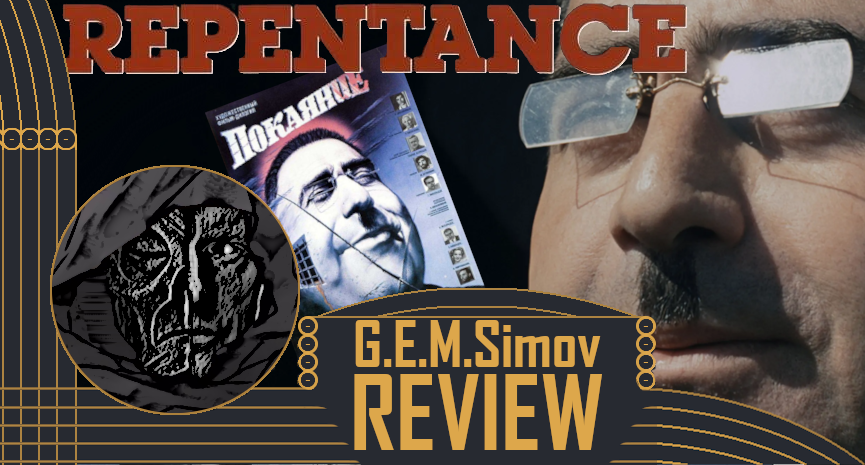
Does the appearance of an actor count as their acting? If so, then this movie is propelled into the stratosphere of acting excellence, far surpassing any other film to have ever been shot. Avtandil Makharadze looks incredible - mainly on the poster, but in the film as well. And the performance he gives is very scintillating - mainly because there’s at least two performances that he gives in this movie, first that of Varlam and then that of Avel, Varlam’s son.
There’s just something in the way he is styled, in the way he carries himself for the role, in the appearance and even the air around him - it is stupefying. Really, really good.
The other actors, too, do a good job. I think that is the case, though there was a particular moment wherein a character was crying - supposedly - at a moment that appeared to be beyond hopeless, at which every possible avenue for escape was lost irreversibly, and an unmitigated dread set upon that character… And there was no tears. I might be very nasty here, but I think that in a situation such as this, wherein the character collapses on the stairs and starts weeping, having realized that their beloved is gone forever, having realized that their own future is so uncertain that the only certainty within it is that they will die, and having recognized that their child might grow up without parents and will definitely suffer boundless torment…
I’d wager a tear is meant to come out, but it didn’t.
Apart from that, there are a few moments that had me scratching my head. Maybe that’s all because of the age of the film, maybe that’s because of the fact that some of the actors (presumably?) were switching from theater, or maybe it is because the performances were just somewhat bad, I can’t rate them as good.
I do have to admit that I found the actor portraying Sandro to look quite pleasing to the eye, in a different, far more dignified and generous manner than what Avtandil did for Varlam’s character. Good casting, I figure, coupled with some good acting, but then also some lacking performances. 2/3
Story
Now here’s the big can of worms, folks. The story of Repentance is the most important part of the film, as well as the most valuable part of it. It showcases a large number of things - rather than just one concept or topic - and that helps it a lot, due to the fact that it makes it believable, in a sense, or rather leaves it grounded.
As previously mentioned, this story is all about… It’s all about… It’s not directly about the bad implementation of communism performed by the Soviet Union. It’s not about the Soviet Union itself, either. In fact, there is not a single mention of the union or a single visual piece that might reference the union.
At the same time, though, it can clearly be seen as a critique of the Soviet Union. It can be interpreted as such with incredible ease and the viewer needs not even know much of the Soviet Union, other than the fact that it was bad, to be able to tell that this film is about the Soviet Union… Whilst not being about it.
The film is about the abuse of power, about the fact that power corrupts, about the reality of might making right, about the status quo, about the manner in which one can fight back - or rather can’t - it’s about the consequences of one’s actions…
And it’s also about the sins of the father, which is a concept I despise. It preys upon the total lack of reason humans are capable of and it makes use of it, exclusively. Oh, your father or grandfather did bad things to me, so I will want you to be punished for that?
Right. That’s reasonable, that’s very, very human. Of course.
In any case, I somewhat dislike the idea of spoiling the film. It might be 40 years old, but it’s something western audiences likely have never even heard of, and are much less likely to have seen it. Is it worth seeing it? I think so, thus I want to keep the story unspoiled for these potential audiences.
But I have to say something about it. So let me go on about how I quite liked some aspects of it.
Varlam, the main ‘villain’, is dead. He gets buried by his family and then, on the next day, he shows up in their garden. The corpse, that is. Shock, awe, terror - put ‘em back in there. He gets buried once more, but on the next day - guess what - he’s back in the garden, arms crossed over his chest, leaning against the trunk of a tree. Still very dead.
Eventually the family finds who it is that has been digging up Varlam and puts them to court. Turns out, though, that there’s more to it than that. The dig-upper reveals their past has been heavily influenced by Varlam and a decent chunk of the movie takes place in the past. It’s almost 50/50.
In the past, we get to see Varlam and the things he has done. We get to see some interesting explorations of concepts and topics, such as… What did the people in charge think? How did they feel?
It was an interesting way of humanizing the villains, the ones at the peak of power (in the Soviet Union or other similar state arrangements, read: “the USA”), who wield the fates of countless (for them) humans. You know, their decisions need to be justified, no matter how rotten they may be. In the case of Varlam, he justifies them in a certain way.
All those who get stricken by the regime he’s enforcing are evil. They’re enemies of the state, the people, they are actively working against him and his way of life, against his livelihood. They - these ‘enemies of the state’ - want to harm him, because if they were to do their thing, then he would get a stern talking to from the big guy in Moscow… Or maybe something far worse than a stern talking to.
Then again, however, it is not that well implied. It is not hinted at so strongly. It’s just Varlam dealing with his own demons, which demons seem to stem from the fact that he is a cultured, erudite man that’s fallen in the trap of the party, if we can so call it.
It’s intriguing, because there’s a struggle. One sees it and thinks to themselves that there is a struggle. There are things that Varlam does which seem to evenly match what the party would do, the terror that it ought to engage in. There are moments when it appears as though Varlam showcases humanity, even though he is partaking in inhuman activities.
That is interesting. It is so fascinating to see him made human, even if he retains the monstrosity required to be a big wig in one such situation. Other things that I found curious were the way things go after the fact.
Varlam might be dead, but the members of his family go about the things they do as if they are completely normal. They appear to be buddies with the leaders of the mafia, whilst also having their fingers so far up the asses of most government officials that it’s as though they’re playing with dolls.
Though the most incredible thing is that they don’t even flinch. Everything proposed is horrible, but for them it is normal. It is the way things are… And that I find to be most frightening. Even though it takes a younger person, one with a more defined conscience, to see the discrepancies, the sight takes this young human’s life. The future is threatened by the past, the horrendous systems developed by their predecessors and by the vile status quo.
The funny thing here is that, while this is a veiled critique of the USSR, the solution to these problems is a proper implementation of communism. That’s the most funny aspect of it. The most intriguing aspect of it all, however, is that these sights are common in our current society. In the world as it is now.
Exploitation of people? Check. Impunity before the law? Check. Delusions of rightness? Check. The way things are, currently, is the exact same as it is in the movie. But hey, it’s only cheating if you get caught doing it. It’s only murder if you get caught doing it. It’s only wrong if someone else ascertains that it is.
The story was great. The fact that it was perfectly applicable even today was terrifying. 3/3
Legendary Point
Does this film get the legendary point, so craved and wanted by all and none at the same time? It gave me COVID (it didn’t), because I went to see it in an actual cinema, so I’d say getting the coof (as it is terminologically known) in exchange for a good movie was cool.
I will, however, say that Repentance… Ah, I can’t decide. On the one half, it’s a good movie. And the poster for it is astounding. I love it to death. But, then, on the other half of the coin, I don’t want to give it the point. It’s a movie about how fucked up everything was and still is. It’s a movie about how good humans are at being unreasonable and more animal than human. I despise that.
Thus… It’s a mixed bag in which the NO weighs a bit more than the yes. 0/1
Conclusion
7/10. A good movie. A VERY good movie, one that SHOULD be seen by pretty much everyone, because if you think your country is not susceptible to the woes that are depicted, and if you think that people in power are actually deserving of their positions, well… You’re in need of help to see how things truly stand.
It’s a movie everyone needs to watch, frankly.
I tuck it under my belt, another shining achievement that I proudly display. It might be a bit old and yellowed from the sun, but it is fantastic still.