Totalitarianism in the caricatures of Todor Tsonev | a Review
originally published on 16/12/2022;
Hello everyone, I am the artist who finds himself indirectly repressed by society, G.E.M.Simov, a goon of cosmic communist power, and today I'll be using pictures to tell you about Maria Ovcharova's "Totalitarianism in the caricatures of Todor Tsonev".
Simple review details - I rank, or try to rank, books on an out of 10 basis, granting up to 3 points in 3 categories, as well as a last, single point from my own self, depending on my experience with it.
Content
This is a book, a Bulgarian book, about the funky totalitarian regime (that naturally claims it is definitely not a totalitarian regime) that reigned from 1946 to 1990. The book mainly focuses on the exploits of the dictator - the General Secretary of the People's Republic of Bulgaria (PRB, very similar to another dreadful realm currently ravaged by totalitarianism, the PRC), Todor Zhivkov, who ruled over the country for an impressive 35 years and lived with near total impunity.
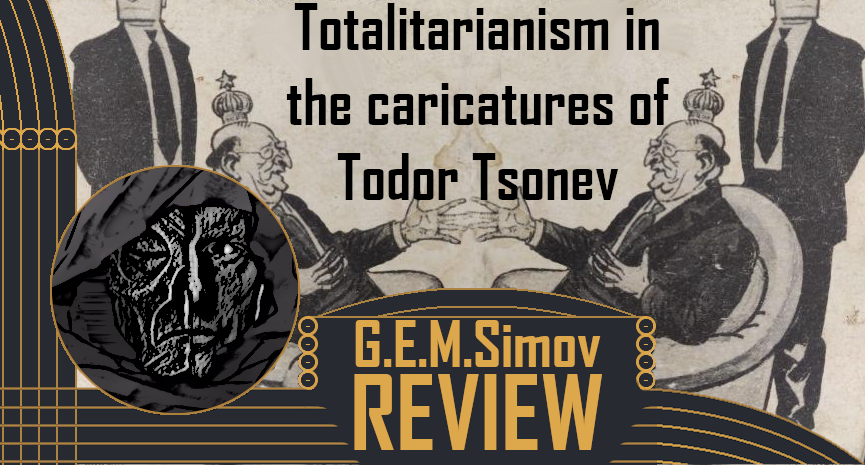
However, it isn't a book that focuses on totalitarianism itself - not through its text, even if totalitarianism is present and spoken of within said text. The presence of totalitarianism in this book is found within the plentiful caricatures that take up around 200 pages in said books, which paintings feature the aforementioned Todor Zhivkov, as well as some familiar faces - Stalin, Brezhnev, even Gorbachev (RIP) - and a slew of other goons, all depicted appropriately.
The text of the book is a monstrously biased retelling of the life of the painter of said caricatures - Todor Tsonev - and also focuses on the presentation of said collection of paintings at a certain Gallery in the capital of Bulgaria, Sofia.
The unfortunately biased approach to the manner of the retelling makes the adventure of experiencing totalitarianism's wondrous features an arduous task, as the reader needs to sift through adjectives and qualitative statements that should not have been present, and then also some praise that starts turning the reader off.
The things that are truly interesting - the mechanisms through which 'the party' operates and attempts to get a justification for the arrest of Todor Tsonev, the things that happen throughout his life, as well as the things he is subject to - those are what is truly interesting, not the overly colorful tale told by Maria Ovcharova.
Now, I've no doubt that Tsonev deserves the praise - I took the time to look at the caricatures and considered what was said of the presentation of this collection in that one gallery. I found it reasonably compatible, in the sense that what I drew from those pictures was easily discoverable in what was described as the feeling, or emotion at the Gallery. What I am against is the way in which he was presented, as a great hero with such unmatched skills that it's a wonder he has not been granted worldwide renown.
Not only that, but I was far more interested in the aspect of the book that is written with the big, eye-catching, orange letters that stick out on the cover, rather than the subtitle-esque, tiny little letters informing me that this book is actually about Todor Tsonev.
In an addition that I feel is very appropriately made, this book works as a means of counter-propaganda, in the sense of being its own kind of propaganda, rather than being something that undoes, or attempts to undo, the damage caused by propaganda. The author of this does not attempt to limit the expression of their own opinion, even if this is a pseudo-historical, or at least biographical, work, and those are supposed to be as free of that as possible.
It becomes clear that this text, accompanying the book, is more of an oddity that tends to appear alongside paintings that get shown on Presentations in Galleries, rather than a proper literary piece. The book is, after all, supposedly an album, which explains things.
Either way, this book contains more paintings than text. The paintings are great stuff, but they don't constitute the content I am looking for in a book, and the content that is present, well… 1/3
Richness of Expression
This book is filled with no small number of words. In addition to that, a large number of the words filling this book are somewhat needless, which makes their presence a mistake. The richness of one's expression is not bound exclusively to the rarity of the word spoken, but, rather, the appropriateness of the words used.
In the case of this book, there is a lack of appropriateness. An example would be the fact that a divorce is called evil and then the two parties - the woman and man in that divorce - are called selfish for going on with their lives, rather than being called such for their deeds in regards to their children.
Thus, even though the book is well written and moves along quite seamlessly, the presence of these needless things is a problem. 2/3
Story
The story of a human being is always something interesting. Doubly so if it is told well. The story of a human being living through unusual, for the listener or reader, times is also far more interesting than it would otherwise be.
As a result of that, for people who are not unlucky enough to have lived through these times, hearing a story of a person persecuted for his attempts at reacting to the way his own country was run, a person persecuted for expressing his views through art… That is quite the story to hear.
However, the means of presentation are very invasive and grow quite unpleasant as it goes. While the story of Todor Tsonev could have been very interesting as it was, it was made lesser by its presentation. 2/3
Legendary Point
Does this book get the legendary point, so craved and wanted by all and none at the same time? NO, I say, and my words are resounding. It was incredibly interesting as something to take a look at, as a means of connecting to the past, as a means of reminding oneself that we are slowly headed down that same road, because everyone in the position of leadership somehow winds up being someone who wants to be in charge, and then that's because being in charge would be most beneficial, so…
Let's not beat around the bush. This book could have obtained the legendary point, but it did not, because of the way it squandered its potential. Nice paintings, lackluster text. 0/1
Conclusion
5/10. If I were to call it average, I'd be lying. It's not a good book, but its brevity manages to make it a manageable read - especially due to the fact that it is paired up with a large number of wonderful illustrations. I'd advise the reader to either buy this book if they want to have a physical copy of the caricatures… And, really, under no other circumstances.
In the bag of mediocrity I send it, to gather dust. If I was looking at it as a collection of paintings, then it would've been better, but as a book, it almost stinks. Let's cover it in dust and forget about it.