CLONES! | a Review
originally published on 26/02/2024;
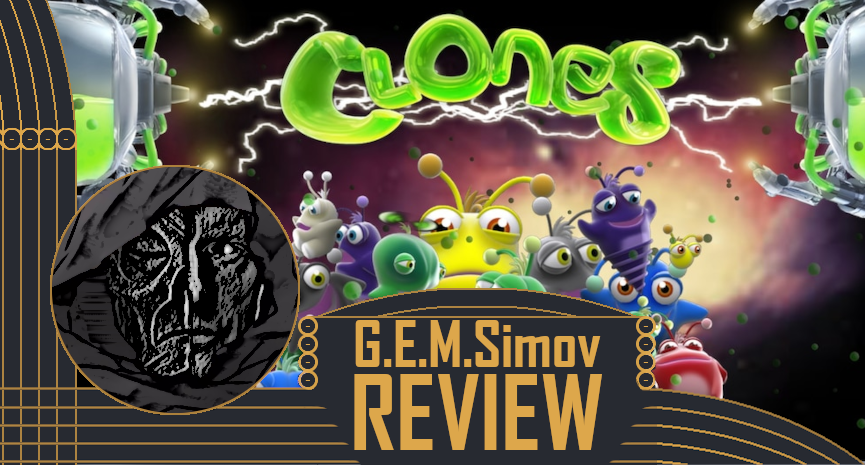
Hello everyone, I am the one and only, totally unique, G.E.M.Simov, a person definitely not sporting a couple of clones in some funky lab, here to tell you about the game “CLONES!” (henceforth just Clones).
Simple review details - I rank games on an out of 10 basis, granting up to 3 points in 3 categories, as well as a last, single point from my own self, depending on my experience with it.
Gameplay
Clones is a puzzle game that is strikingly similar to Lemmings, for those of you who do know what that is. It features a vast number of levels, with hazards and objects strewn about them, an entry point and an exit point, and a number of creatures that come in, start walking and never stop, until they either die due to a hazard or escape through the exit point.
In Clones, the way to make sure however many little creatures are needed to escape… escape, is by making individual clones(that's what they are called) morph. By morphing, a clone starts doing something other than just walking. It could be drilling down, drilling sideways, it could be or all kinds of other funky means of level interaction. The interesting part is that these can be canceled - or undone - by ordering the clone to just walk.
That creates an opportunity for impressive amounts of micro-management, which was already going to be needed to deal with the levels that were about to present themselves before the Player, but with the opportunity, and maybe even necessity, to stop clone activities, it goes on to a slightly more elevated playing field.
So, this puzzle game has the potential to be obscenely complex. That's great, but what is it that will make it complex? The levels that are presented, naturally. They feature a number of terrain types and many objects, with the former being terrain that can be interacted with (drilled through), terrain that can't be interacted with, but can be walked over, and terrain that isn't quite terrain but is liquid, meaning it can be interacted with in some manner, but it can not be walked over.
For objects, there are some that can be beneficial, such as launchers that propel clones a certain distance, and ones that can be detrimental, such as berserk or enemy clones, while others yet might be necessary to accommodate, like star clones.
Those - berserk clones - use clone abilities to impede the Player’s progress, while enemy clones use a specific clone ability that can kill other clones. Lastly, star clones are ones that need to be guided to the exit, but can not be controlled by the Player (as in they can not be made to morph).
That complicates things - and the game does not play around when it comes to introducing difficulty to its levels - but there is another thing that makes things even harder. QDots are objects that appear in the levels and can be collected. To truly complete a level, the Player must not only finish it by reaching the escape spot with as many clones as is necessary, but they must also collect all QDots, which are in really out-of-the-way spots, thus creating an even greater challenge.
With all that said, this game is for children, as is going to be discussed in the Presentation section of the review. The main reason that is so is not only the appearance of the game, not only the fact that it is a very mentally stimulating experience that would be best for a child that is still developing, but also because every level features its solution, in video form, within itself. Simply enter the menu, while in a level, and select the “Show Solution” button, and it’s all done.
That is commendable, as it is indicative of the developers knowing their audience and envisioning either a situation in which the child playing has no idea how to beat a level and quits all together, or a situation in which a child asks their parent for help with the level, and the parent can make use of that functionality to offer guidance. Alternatively, though, it is not commendable, because it presents the means of beating every level without any effort, which would definitely be against the spirit of the game.
On yet another hand, having those in the game means there’s little reason to go on the internet and find solutions to the puzzles… Though those Solutions, which the game presents, do not feature how to get all the QDots.
Lastly, there are some weird “battle mode” levels, which require the engagement in competition with the AI, in which the clones have some amount of energy, and to win the Player needs to get more clones with more energy to the escape point than the AI. It's essentially just another level, but with a slightly stricter set of rules on how it can be beaten.
Regardless, this is a very neat game. It presents some really cool puzzles, coupled with a level editor, but it is plagued by bugs - clones going through holes that they have no reasonable way of going through, as an example - and featuring some very odd design choices. Overall? It is a Lemmings clone, it gets the Lemmings score 2/3
Presentation
There’s something odd about the way Clones looks, sounds and feels. It's a 2D side-scroller game, with the playing field on display being the level as seen from the side, as though one were looking at an ant farm. It looks almost exactly like Lemmings, though it features a lot more detail and higher visual fidelity. The levels also have many things happening in the background or in unreachable areas, featuring other clones going about their business, or mechanical gadgets and doohickeys doing their thing.
There are many tiny cinematics littered throughout the game, all of which are short introductions to "clone masters", which look like the entrances of fighters from Street Fighter or Mortal Kombat, complete with them saying something (their name) and performing a funky action move (the activity in their name). These back up the point that this game is made for children. The odd thing about them is that they do not automatically play and must, instead, be manually started, which means a large number of Players might simply miss them.
However, the User Interface (UI) does not exactly concur with that - the idea that this is a kids game. It is sleek and gray, featuring many buttons and many options, showcasing a complexity that would not be expected out of a children's game. In fact, it is so convoluted that only through paying attention to the tutorial can one understand what it is about - which means it is very counter intuitive, which is problematic when it comes to something that's made for kids.
One failure of the UI would be the fact that there are keyboard shortcuts for each available morph, which are shown in the corner of the button for the respective morph, however there are times when the clone depicted on the button is the same color as the letter depicting the shortcut, making it almost impossible to discern which keyboard button is being shown.
It keeps doing these strange things - when it comes to the tutorial, it describes things in a manner that is not as good as it could be. When urged to click a glowing rock by a welcome sign, the Player is more likely to click the crystal that shimmers in a shiny purple glow, with the visual effect of a twinkle, rather than a circular, gray thing that is pulsating. This is incredibly odd and, also, problematic, for the clarity of the game is trying to tell the Player is compromised.
The tutorial, however, is a lot more coherent and quite clear. It does lack a few bits of polish, though it manages to slowly introduce the Player to almost everything they need to be acquainted with… Though there are massive exceptions, such as the pause button (which does not get introduced).
In regards to sound effects and music, I'd like to say that the game handles the job adequately, but I would be lying. There are strange things that happen with it - even in the main menu of the game, which features a musical track that is incredibly quiet, nearly absent, in the listener's right ear, but it is loud and clean in the left. That's beyond odd… And it does not only happen in the main menu. In fact, almost every level of the game features that musical track which is nearly silent in one ear and loud and clear in the other. That's a VERY major problem!
Overall, the game presents itself decently well. It has a large number of faults, but it does possess a bit of charm that allows it to weasel its way into being better than it is bad. 2/3
Story
Surprisingly, there is some semblance of story. The Player (Character?) is a trainee who is learning how to be a CloneMaster. Other CloneMasters teach the Player how to be a CloneMaster by way of these puzzles (the levels) and the occasional contest (the battles). Unfortunately, that's nearly as far as it goes.
There is a bit more to it, involving the collection of a number of medallion fragments, granted as a means of recognizing one's… Well, it does not matter. The story here is simply present so that it can be said that it is present, so that the tutorials are not exclusively META text.
I'm not willing to give Clones even a single point for this, though, because there is really no story to it. 0/3
Legendary Point
Does this game get the legendary point, so craved and wanted by all and none at the same time? No, Clones does not get it, no matter how funky the level editor is. 0/1
Conclusion
4/10. I said it would get the Lemmings score, and it did get the Lemmings score. It's an amazing game for children, and for folks who like to solve puzzles. It'd also be great for older folks, to keep their brains working and perhaps help stave off some of those terrible things that threaten mankind.
I will, however, put it in the bag of mediocrity, for there is dust to be gathered.