Grim Clicker | a Review
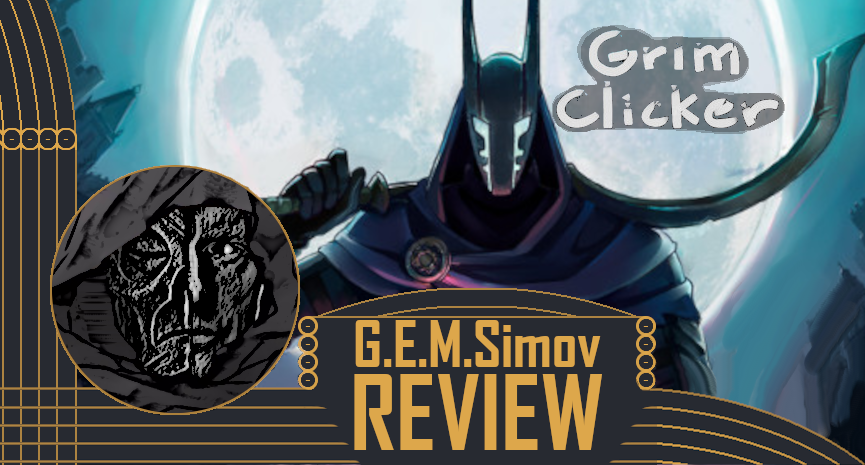
originally published on 12/12/2023;
Hello everyone, I am the brooding G.E.M.Simov, a grim-dark antihero/villain, here to tell you about the idle game: “Grim Clicker”.
Simple review details - I rank games on an out of 10 basis, granting up to 3 points in 3 categories, as well as a last, single point from my own self, depending on my experience with it.
In addition to that, this is an IDLE game. Those are barely proper games and so I will put in less effort with reviewing them than I would otherwise.
Gameplay
Grim Clicker claims to be influenced by titles like Diablo and Dark Souls, but that would only extend to either the aesthetic of the games (in the case of Dark Souls) or the aesthetic and the intense grind (of Diablo).
In truth, however, it is far more influenced by games like Tap Ninja and Idle Slayer - because it plays almost exactly like an odd combination of them!
The Player Character(PC) is a goon situated at the left hand side of the screen, and he infinitely walks towards the right side of the screen. The Player can click to make him go faster, which is as far as the basic mechanics of what the Player can do to actively and directly influence the game go.
There are, of course, other things the Player can do, but they are consequences of preceding mechanics. The main course is the enemy mechanic - while running to the right, the PC will encounter enemies, who are running from the right of the screen to the left. When the PC collides with an enemy, a fight will begin. It involves standing and waiting for the PC to hit the enemy enough times for its health to go down to 0.
It is important to note that enemy health increases by 1 for each enemy that has been defeated. Another means of health increase for the enemies is through Zone changes - whenever the PC kills a certain number of enemies in a Zone, a portal will appear on the screen which, when reached, will take the PC to a new Zone, which might feature new enemies, or it won't, but it will certainly feature enemies with double the health of previous Zone enemies. Keep that in mind.
It is even more important to note that when an enemy dies, it releases blood gems or rubies or something along those lines - there is no clear indication as to what the red objects are called, except for a few lines of text in the descriptions of upgrades or weapons - hovering over the icon for the rubies does not tell the Player that those are rubies - so I will refer to them as rubies. The higher the Zone’s number, the higher the amount of rubies that are released.
These rubies are one of the other ways the Player might be able to influence the game - for they sometimes get collected automatically, but other times they need to have the mouse’s cursor pass over them… Though, at the same time, it could be the PC that passess over them and collects them. So already we have a mechanic that supposedly relies on the Player, but in truth is only there as a means of providing them with something to do while waiting.
The problem here is a Presentation based issue, but it directly affects gameplay. What actually happens with the way rubies are collected is that there is an area around the cursor that, upon intersecting with a blood gem, collects the blood gem. Well, unfortunately, that is not told to the Player, nor is the Player told that rubies de-spawn whenever they wind up off screen, or that they can fall off-screen from the entities that produce them, which is even more problematic.
The same applies to another currency - Candles - though those seem to have some protections in place, as the way they pop out and get strewn about is more controlled… Even so, they can also wind up off screen and de-spawn. More on Candles later, but the issue here is that rubies are so esoteric and valuable, yet, at the same time the game treats them in such a manner that it appears as though they are worthless.
That’s not good.
As mentioned, this is an idle game. It being called “Grim Clicker” suggests there’s going to be more to it - such as clicking - but already it appears as though that is not entirely the case, because it is resorting to giving the Player the illusion of doing something, when, in reality, the Player is not doing anything and is, instead, just waiting for the PC to kill the enemy.
That’s the thing - enemies, with their infinitely increasing health, become more and more time-consuming to kill, especially when one considers the amount of damage the PC does per hit. It starts off very low - 1 damage per hit - and when enemies can go up to having 50 and more health, that’s a bit problematic.
Fear not, though, for that can be alleviated via either leveling up OR upgrading a weapon. Upgrading weapons costs rubies, and so the Player needs to kill a few enemies to do so. Leveling up requires the death of a far larger number of enemies, and the number increases exponentially, because we need to stick to the funky (and bad) conventional approaches to handling experience and levels.
Regardless, those two ways of increasing power are the most conventional. But there is another! See, when I spoke of Player agency, I failed to mention that clicking, while fighting an enemy, causes the PC to immediately perform an attack. Thus, the Player can speed up the rate at which the PC kills enemies by clicking violently, though I did not mention that fact, because it was not presented through a tutorial or by the game at all.
What the game did present to the Player, though, is that they can click to speed their PC up… Then again, this is a Presentation issue, and thus I will leave it for that section. But is this not good? The game, called “Grim Clicker”, actually relies on clicking? Well, it is not as good as it could be, for this game has limitations set in place to corral the fun the Player can derive from it, and to slow their progression further.
Clicking to attack consumes 1 point of Energy. Without Energy, clicking to attack will not yield an attack. In fact, when one is at 0 or less Energy, the PC will not even perform that automatic attack that is otherwise performed. So, how does one increase their Energy? By putting points into Dexterity.
That takes us back to levels. Upon leveling up, the Player gains 3 skill points they can invest into either Strength, Dexterity or Wisdom. Strength increases Damage done, Dexterity increases Energy and the chance to Critically strike, and Wisdom increases Mana regeneration. Then, there are also secondary skills that require a certain amount of Strength/Dexterity/Wisdom to be acquirable, which provide other bonuses.
Well, that’s only 33% of them. The other 67% are spells - active abilities which do something when used, requiring a certain amount of Mana to be cast. These range in effect from being somewhat useless to being very useful, but, overall, they are a boon.
The really interesting stuff comes from the passive bonuses provided by the secondary skills. Some of them are incredibly game-changing, such as that one which provides energy for every enemy killed, which can potentially allow for some funky business, or that other one which provides the Player with a chance to spawn a Firefly whenever a Critical Strike occurs.
Now, what are Fireflies? Well, in short, they are big sacks of rubies that need to be clicked to pop. They are a funky way of forcing the Player to not just leave the game infinitely running in the background. There are also Bats, which are like Fireflies but faster, drop more rubies and are very beneficially affected by some of the Player’s passive skills.
But at one point the Player will run into a wall, even if they are getting strong off of their levels and rubies. At that point, they would have collected some Candles, which drop off of Bosses and Champions (both stronger enemies than ordinary, more on them later). Candles are the resource required to perform the classic in the Idle game genre - the reset.
Resets in this game are called Rituals, and they remove almost everything - except the premium currency and Black Wax (the reset currency). What they do is that they take the number of Candles the Player has and transform them into Black Wax, which can be used in the shop to purchase upgrades that persist through Rituals and increase things such as the value of rubies, the amount of experience earned and whether consumables get consumed.
There are also reset resets, which are supposedly transitions from one galaxy to another, taking place when the player beats Zone 40, which reset EVERYTHING except purchases with the premium currency. They provide the Player with “Knowledge of the World” (KoW), yet another pseudo-currency, and Singularities. Each KoW moves the Player 1 slot forward on what is, essentially, a “battle pass”, providing them with chests, items and the occasional boon. There is also a premium tree of the battle pass (unlocked with the premium currency) which is just a second battle pass - double the bonuses.
Then, Singularities are the omega reset - they reset the previous collection of resets, essentially resetting the Battle Pass gotten through KoW, and allow for the selection of a Star Sign via the expenditure of a Singularity, which provides some sort of funky bonus (as expected). On top of that, every time a new Singularity is earned, a new mechanic is added (or a new type of star sign is added), which further increases the playtime of the game.
Naturally, though, the real power comes from the premium currency, which is called “Shards”. Shards can be obtained through the completion of quests - which are tiny tasks requiring some grinding, such as killing 200 enemies, performing 5 Rituals or killing 20 champions - or by buying them with real money. And Shards are magnificently strong - for 300 of them the Player can make it so they get 4 skill points per level, instead of 3. Or they can make sure they get 1 Skill Point at the start of a Ritual, without even leveling up. Or they can double the value of Rubies, or double the amount of Black Wax earned from Candles - in short, the game relies on being long and bothersome, as well as inconvenient, so that the Player will be willing to pay for convenience and power in the store.
Alternatively, the Player can skip over some other mechanics and just buy items, or chests - chests, which are earned by completing achievements, killing bosses or suing Black Wax. These chests can contain items - such as extra weapons, which increase the damage done by the PC by tremendous amounts, stones - which add new effects to weapons (with weapons being able to contain 2 stones), consumables - which provide all kinds of bonuses, rubies or Black Wax.
As a result of that the integrity of the game is thoroughly compromised. The Player can just pay to win at it. The way to do micro-transactions should be through cosmetics - add suits for the main character that can be bought, add suits for the enemies, add some other visual elements - don’t add power. That’s just wrong, because it essentially legitimizes cheating.
Regardless, let me get to bosses - bosses are obtusely massive enemies who occupy the entirety of a certain zone and provide the Player with a timer. If the timer expires and the boss has not been beaten, the PC will be transported back to the previous Zone. If the boss is beaten, they drop a large number of rubies, Candles and a special boss chest.
That special boss chest only drops every five times a boss is defeated, so enjoy getting one of those every 20 hours! In that special boss chest can be found many items, as well as a boss soul - the boss soul is the real treasure here, because it allows for automation.
The more of those that the Player gets their hands on, the more things can be automated or improved. The Soul can click on the screen, it can increase the rate at which Energy and Mana are recovered, it can improve Critical strikes - it does almost everything. And, of course, the more souls that are relegated to doing a certain thing, the more efficient they are at doing it, and the better the thing is. As previously mentioned, they can be obtained through boss chests, which can be obtained with the premium currency, so it’s all funneling back into making the Player pay.
Lastly, there’s a crafting mechanic in the game. Crafting features two options - upgrade item (weapon) which increases the number of stones that can be inserted into the weapon; and insert a stone into a weapon. To upgrade an item one needs metals, and metals are obtained by dismantling items, which is the third crafting option, which I’m not considering a proper option, but, rather, a sub-option, as it is a necessary step for upgrading items.
Upgrading an item requires the disassembly of at least 5 other items, so, again - there is incentive to buy Shards to get chests so that the Player can progress without having to dedicate multiple hours to this.
Overall? A neat looking game with some interesting ideas - namely the leveling up and experience, coupled with the multitude of spells - that starts off at a decent pace and then slows down to a crawl, urging the Player to pay. No matter how intriguing and how multiple the means of approaching the game are, and how many somewhat meaningful choices the Player can make, the fact that one can just pay to win undermines it all. 1/3
Presentation
This is where Grim Clicker can honestly claim to be inspired by the games it claims to be inspired by - Grim Dawn, Diablo and Dark Souls. In the Presentation department, Grim Clicker looks pretty promising - even good.
It relies on pixel-based graphics, though things are not too-low in regards to fidelity. Pixel art is, as I have stated in previous reviews, something very impressive when done right, and I’d say that in this game it is done right. The backdrops are very pretty, and they stick to the grim-dark aesthetic the game is going for quite successfully. On top of that, the sprites utilized for the enemies look okay, with some even being good.
The PC does not look that interesting or impressive, which is an unfortunate thing, seeing as that Character is what the Player will be looking at constantly. However, that can be changed by the use of a certain spell - there are a small number of spells that have massive gameplay effects while also changing the appearance of the PC, which is neat, though not a truly proper solution. The User Interface also has a certain look to it, definitely drawing inspiration from Diablo, thanks to the utilization of big, glass-esque spheres to indicate Mana and Energy.
The most pleasant aspect of this game’s Presentation is the audio, with an emphasis on the music and ambience that are utilized. Some of the tracks are incredibly good, while others are a bit out of place, which creates an odd mix. The good tracks are perfectly fitting for a grim-dark game, evocative of Diablo 2’s own soundtrack, whereas the ones that are out of place would be better suited for… I can’t quite tell. The Ambiance is, overall, very good.
So that presents us with something that’s a bit of a mixed bag, but mostly good. Well, let me return to the subject of tutorials, and how the game presents what the Player can do. In short - it does not happen in a very good manner.
The Player is informed that currencies are important. The Player is informed that killing enemies is good. The Player is informed that upgrading their weapon is good. The Player is not informed that they can click to attack, they are only informed that they can click to speed things up. In addition to that, the Player is not informed what consumes Energy, or that attacking requires energy.
It feels as though the tutorials are insufficient, and yet there is plenty of information to be gleaned from the menus corresponding to certain mechanics, because they present the opportunity to hover one’s cursor over a question mark and become informed. Though there are things that the Player remains uninformed on - such as which enemies drop candles, which enemies drop rubies, how blood gem collection works, what skills that are not yet available do, and so on.
The Player is kept in the dark about things that they should not be kept in the dark on, and that’s not good. Overall, though, it does not detract too tremendously, and the game’s presentation is still more than passable. 2/3
Story
There is no story. Actually, there are some smidges of something - the PC is traveling through galaxies and black holes and what-not, but it is all just background noise. There is no actual story. 0/3
Legendary Point
Does this game get the legendary point, so craved and wanted by all and none at the same time? No. It’s an idle game that does something decently interesting and then goes on to be an idle game. 0/1
Conclusion
3/10. A bad game overall, but, for an Idle game, reasonably average. It looks neat and has a funky mechanic, and that’s about it. For fans of idle games, you masochists, it might do the trick. For anyone else, flee and do your best not to touch it!
On the wall of shame I hang this game, may it be covered in dust and forgotten. What a shame, indeed.