Soda Dungeon | a Review
originally published on 18/10/2023;
Hello everyone, I am the ex-Soda junkie, G.E.M.Simov, a man so distraught at the horrible deeds performed by the soda manufacturers that I've decided to amass enough wealth to overthrow them, and so I'll tell you about Soda Dungeon.
Simple review details - I rank games on an out of 10 basis, granting up to 3 points in 3 categories, as well as a last, single point from my own self, depending on my experience with it.
In addition to that, this is an IDLE game. Those are barely proper games and so I will put in less effort with reviewing them than I would otherwise.
Gameplay
This idle game is a bit unlike other idle games, in the sense that it does not focus on passive income. The Player retains the ability to influence almost everything that happens, with there being an option for automation, but, generally, this game does not emphasize clicking and obtaining things that make clicking pointless.
With that said, let me elaborate. In Soda Dungeon, the Player has five party slots. Those slots are to be filled with Characters, and then these Characters are to be sent to the Dungeon. Then, the Player controls these Characters in a large number of turn-based fights, with the goal being to reach as far as possible.
These fights occur in a relatively simple manner - the Characters in the Player's party go first, with each having a turn. During that turn, the Player can select what kind of ability the Character uses - a basic attack, a special ability, or an item - and selects the target, be it an allied Character or an Enemy. After every one of the Player's Characters has had their turn, the Enemies (if alive) have their turns. After the Enemies have had their turns, a new round begins, and the Player's Characters get to have their turns again.
Now, each entity - Characters and Enemies - has a certain amount of health and, whenever attacking, does a certain amount of damage. If an entity's Health drops to 0, that entity dies and is removed from the fight. If all Enemies die first, the Player's Characters move on to the next fight (any who have died stay dead). If all of the Player's Characters die, the Dungeon "attempt" ends and the Player is sent back to the Main Screen.
On the Main Screen, at least initially, the Player only has access to the Tavern and the Dungeon. Later on in the game, after progressing a bit, the Player will get access to more things - such as the ability to go to a new Dimension, the ability to engage in “pretend PvP”, the option to enter a special Dungeon and more.
In the Tavern, the Player has access to a trio of shops - the Tavern shop, the Smith shop and the Wizard shop. The latter two are obtained through the Tavern shop, which features upgrades for the Tavern itself, upgrades for the Player and even more goodies.
So, the Player can hire Characters to get in their party, to fill up those aforementioned party slots. To do so, there must first be Characters in the Tavern, which needs to be upgraded to increase the rate of Character appearance in it. In addition, there are multiple types of Characters, but they need to be unlocked first - again, via the Tavern upgrade system.
To upgrade anything, the Player needs Gold. Gold is obtained by fighting in the Dungeon, but it can also be obtained by selling Items to the Smith. Items are another thing that gets found in the Dungeon, and they can also be equipped by the Characters the Player recruits, making them stronger. Some items increase the Characters’ Attack, some increase their Health Points, others increase their Magic Points, others yet provide special passive bonuses or subtract from one stat to increase another.
The item system is really interesting, and it is exclusively what the Smith shop in the Tavern is about. The Player can buy items from the Smith shop or sell items for profit, and items are strictly necessary to succeed, because without the stat increases they provide, the Player’s party simply can not make it through the game.
There is an issue with the item system - and that is the fact that items are automatically equipped, which is convenient, but the items that get equipped are those obtained from the highest level of the Dungeon. So, often-times there are situations in which an item would give 10 Health Points and 10 Attack, but due to the fact it drops from the 70th floor of the Dungeon, it is not equipped, and, instead, an item that takes away 10 Health Points and 10 Attack, but gives 20 Magic Points, is equipped, because it drops from the 80th floor of the Dungeon.
It is problematic, because it negates the positive of having items get automatically equipped, and is an annoyance overall. However, there is a way of solving this issue - an upgrade from the Tavern allows for custom loadouts to be saved. That’s convenient, but it makes one wonder why is it an upgrade and not something that’s a feature as is?
The answer is money. That upgrade costs 250,000 Gold, which will not be attainable for a beginner Player at least until the Player reaches dimension 3. But, it can be purchased for 1 dollar (literally just a dollar, there is no premium Currency associated with it).
The game is purposefully made inconvenient and a solution for that inconvenience is sold to the Player. That’s rough, and not good. Naturally, though, there are other such purchases - the upgrade that allows the Player to see Enemy health, costing 100,000,000 Gold. If the Player wants to see Enemy health, they need to equip an item that allows it, which is utterly useless, but then seeing the health of Enemies is quite convenient…Alas, that’s a bad design choice.
Fortunately, these “premium” options are still attainable through normal means of playing the game, although there’s a LOT of playing that needs to occur before that attainment can take place.
With that said, the game offers the ability to reset - it is, however, only available after the big boss of the current dimension (reset) has been defeated. That would be the boss at level 100 for the first world the Player winds up in, then level 200’s boss, then level 300’s boss, all the way up to level 1000's boss.
Resetting takes away all of the Player’s items, Gold and some of their upgrades (particularly those that unlock new Characters), but, in exchange, the Player receives 2 relics. One of those relics is a choice out of 3, and increases a stat - be it Attack, Health Points, Gold earned, Critical Strike Chance and more - and the other is a relic that increases the stats of a particular Character type.
These Relics can be upgraded by using a Currency only accessible after the Player’s first reset. That Currency is Essence, which the Player gets whenever their Characters kill an Enemy shrouded in purple. Naturally, the Player can also upgrade the Relics by buying a premium Currency, specifically designed for Relics, and using it to get insane advantages.
In fact, the amount of power the Characters get off of Relics is so obtuse that, even without items, they can clean floors up to level 300 and higher, when a reasonably advanced Player, progression-wise, performs a reset. Paying to win… Well, at least it is not a competitive game, even if its integrity has been compromised.
Then there are pets. They provide a bonus to a certain stat and can be leveled up - they gain a level every few hundred (thousand) fights, increasing their effectiveness by the value that was present at the pet’s first level. Those can be, potentially, very beneficial, and they persist through resets, so it’s quite neat.
Alas, the game loses most of its luster when the Player reaches level 1000, because, at that point, it just ends. Well, it does not actually end, but the Player is shoved in a “world” that is endless. Just keep fighting goons, clearing floors, and improving your relics. There’s no end in sight - maybe go for level 10000? 100000? However far you can make it before the game stops being able to render the numbers?
Simply put, it’s a time-waster. It is interesting, simply due to its appearance and concept, but gameplay-wise it is what “Raid: Shadow Legends” is. Literally. Do the same thing an infinite number of times, spending that infinite number of times doing something else and allowing the floors to clear themselves automatically. Even when paying to win, one is hard pressed to really progress at lightning fast speeds, and thus would need hundreds and maybe even thousands of hours to “beat” the game.
The complexity of every idle game is present and captivating. The wonder of what comes next is also here, coupled with the intriguing prospect of new mechanics and ways to waste one’s time. Unfortunately, however, that is not enough to bring it up to being good or even enjoyable past the first… Three or four minutes. 1/3
Presentation
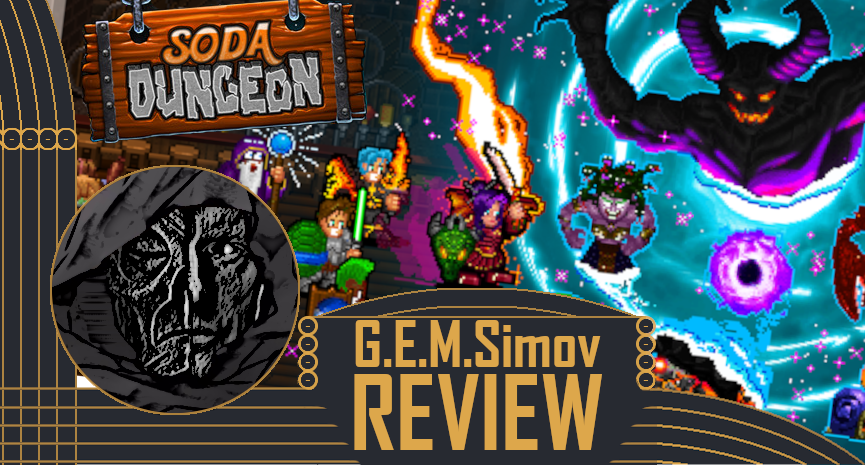
Soda Dungeon makes use of pixels. Big, square pixels are the building block of everything in the game, so they contribute for a very stylized appearance that is also minimalist by necessity.
Unfortunately, I must admit that the Characters employable by the Player are unsightly, and most Enemies are also a bit messy. There are exceptions - mainly the boss Enemies - who have a lot more detail and fidelity to themselves, owed up to the size of the sprites. Items and objects do look neat.
Some visual effects are a bit odd - with a large variety of them being very slow and unskippable. Some sound effects are unpleasantly loud, and they also do not sound exceptionally good.
The music is decent, though it is not something far too impressive.
Overall, the games Presentation is not something immaculate, but it is not bad. However, there are some issues that leave an unpleasant taste in my mouth, yet there are also some very neat things.
An example of neat things would be the bestiary, or the item collection. Those contribute enough to offset some of the oddities, thus managing a passing grade. 2/3
Story
This game has a bit of a story. The Player (Character) is someone who wants to adventure (to get rich), but is too scared. So they figure they can persuade others to do the adventuring for them!
The persuasion happens via the funky sodas that are sold at the local tavern. The Player helps the barkeeper improve the conditions of the rundown tavern, and, in return, the Player gets to recruit the adventurers who come by, follow them into the Dungeon and grab the adventurers' loot when they become overwhelmed and flee.
Other Characters show up over time, most of them attracted by the profitability of the Player's scheme, and the place becomes a bustling location. Well, there’s a Wizard, who, after the Dungeon’s one hundredth floor has been reached, will suggest dimension hopping.
And, while doing dimension hopping, the Player might encounter (God?), who is pleased with what the Player is doing. Then the Player might also encounter some genie-esque thing from the monster afterlife, and they might develop a rapport with the villainous bosses of the new Dungeons they discover…
There’s a bit of fun to be had with the story, and it doesn’t take itself too seriously, nor is it overbearing. Ultimately, it's okay. 2/3
Legendary Point
Does this idle game get the legendary point, so craved and wanted by all and none at the same time? Unfortunately, for all its charm, I'm inclined to say that no, the game does not get the point. 0/1
Conclusion
5/10. A generous score, one that I feel is slightly misleading. This is a game carried by its approach to visuals, light-heartedness and the fact that it does not take itself too seriously. If it did, then it would have been even worse.
It is a game for those who like idle games, for those who like painfully slow progression that does not even come as a result of one’s own deeds, but as a result of the simple consistency found in booting up the game every morning and starting up a new run every time the previous ends. Definitely not recommended to anyone else, though.
In the bag of mediocrity. It could have been good, but it was not. Instead, it simply was.