Syberia | A Review
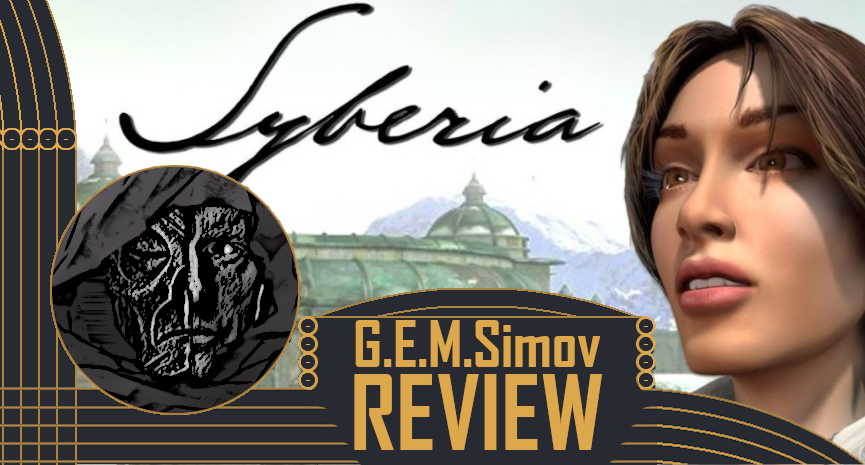
Hello everyone, I am the pre-historic, mammoth of a man, G.E.M.Simov, a doll-esque character that's actually a real human bean, here to tell you about Microids’ game “Syberia”.
Simple review details - I rank games on an out of 10 basis, granting up to 3 points in 3 categories, as well as a last, single point from my own self, depending on my experience with it.
Gameplay
Syberia is a Point and Click Adventure Game, in which the Player controls a Character that walks up to the spot clicked by the Player, or runs to it if it was clicked twice in rapid succession and the terrain shown on the screen allows for running. The Player's Character can also look at things, interact with things and take things and add them into their inventory.
That is, roughly, as far as the number of things the Player can do in the game goes. There is another instance of things doable by the Player, that being talk to other Characters, but this is more similar to interacting with things than not. Lastly, and perhaps most entertainingly, the Player can use a cellphone from their inventory to call certain Characters and engage in conversation with them. The neat part is that the Player must write down or memorize the phone number of said Character so that they can then actually have a chat. It is funky, especially considering how phone numbers work in contemporary times - hardly comparable to that.
Added to this whole thing is the unusual and very alien experience of getting called, on the phone, by many people, many times per day. Gamers in the audience can attest to that being fiction, but in Syberia it happens constantly, and whenever the Player Character receives a call, then that means that the Player has made progress in some regard, or the call itself is an indication that the game recognizes the Player’s activities and has made it so time has passed. It is a neat way to mask checks and event flags.
With that said, the Player will be doing an unpleasantly great amount of walking from screen to screen (with many screens having nothing interactable on them) until they can get to the appropriate screen, where they can click something. It is an Adventure Game through and through, of the exceptionally clicky variety, though aside from that there is really almost nothing to it.
The way this game is played is similar to how most such games are played - the Player finds themselves in a place and then goes on to hover over absolutely everything that they can hover over by using the mouse cursor. If the mouse cursor changes, they immediately click and interact with the thing discovered. If the mouse cursor does not change, then it is probably fine and they can go on to the next screen, only to wind up stuck on something and then realize that they missed something, so that they can then go back and start hovering the mouse even more carefully over everything that vaguely resembles an object.
This is the whole game, with the caveat that, sometimes, the Player must enter their character’s inventory, click an item and then drag it over to an object on screen to interact with the object via said item. It is not exceedingly exciting, but, at the very least, it is not overwhelmingly obtuse.
Surprisingly, this game is not like Adventure Games - the genre. It is a Point and Click Adventure Game, because that is how it is played and because the main character goes on an adventure - there are, however, no ludicrous, inexplicable puzzles that rely on moon logic, nor are there any ‘find the pixel’ extravaganzas… Though, frankly, there are a few stinky situations that the Player will wind up because of the way screen transitions work - which is the following: The cursor of the mouse changes to indicate that there will be a screen transition, however the screen to which the transition will be is dependent on what is beneath the cursor, and two screen transitions can be very close to one another (directly adjacent), resulting in situations that feature the Player finding themselves unaware that they could transition to more than one screen.
Another slight issue that presents itself (which could be related to Presentation, but I think it affects Gameplay more-so than Presentation) is the way camera angles work in the game. Every screen has a certain camera angle, which could make the view really neat, but it could also make some things a bit cramped and obtuse to deal with.
However, those issues I’ve been speaking of are rather minor. Overall, this is one of the finest Adventure Games of the Point and Click variety, because the puzzles are all exceedingly sensible and logical. Not a single one of them features a solution that comes out of nowhere, and even when there is need for a bit of brute forcing, it carries logic with itself, and the Player just needs to check all their options (in the sense that they need to know the colors of their cards, rather than knowing the countless combinations their 64 color cards can make) so as to find the correct one.
There is an emphasis on reading through the things that the Player finds in the world, and by doing so, the Player is going to be prepared for the puzzles and mysteries that present themselves. The more attention they pay to what they come cross, and the more they talk to people and exhaust their dialogue options, the more sensible everything will be, and the easier the game will appear.
That goes to such a level that the game can almost appear too easy, but that is frankly the far superior alternative to being faced with the dreadful, inexplicable challenges of the infamous ‘Point and Click Adventure Game’. Even so, there is something that gets in the way. A certain sense of dissatisfaction, a certain bit of displeasure.
Syberia is slow. It is so, so slow (excrutiatingly so when the Player Character is going up or down any quantity of stairs). As stated, the main Character can run, but it’s not a furious sprint, it’s more of a light jog. It sure does speed things up, but nowhere near enough. Wandering about from place to place, after having already visited the locations once, becomes exceedingly annoying and unpleasant, and there’s a humongous amount of going back and forth in the game - especially in relation to some of the puzzles, so as to figure out if they were solved or not.
To that slowness adds the fact that there seems to be a lot less that the Player can do. Their possible actions are focused on their task at hand, and the Player Character will often say stuff along the lines of: ‘no need to go there’ when the Player tries directing them somewhere off track. Additionally, there is no option to click on things and have the Player Character yap on and on about them, which is a tremendous strength of Point and Click Adventure Games and a slight misfortune for Syberia.
Still, even with all those mishaps that I’ve presented, it remains one of the best devised Point and Click Adventure Games out there; granted, it is old and becomes terribly tedious as soon as the Player misses one thing, but that does not greatly diminish. The puzzles and the feeling of ‘getting it’ whenever something is done, the ‘oooh’ that most clicks yield is… Well, it’s quite pleasant.
However, the game is old. It’s for older machines. Newer ones do not like it, and thanks to that, it is prone to inexplicably crashing, which is a dreadful event when one considers the fact that this game… Has manual saving.
2/3
Presentation
Syberia looks hauntingly beautiful. Haunting, for it is a product of a bygone era, and visuals like that are constantly reaffirmed as being a totally lost art - or, rather, something that is going to remain less than appealing for contemporary developers (or so it seems). Gorgeous environments, decent character sprites, and good animations.
The latter two are good enough at getting the job done, but the first - the backgrounds whereupon the action takes place - are absolutely sublime. Not only that, but the game goes for a very particular vibe, quite adjacent to Steampunk, but being set in contemporary times (the two-thousands). Lots of grand structures, stylized in a most peculiar fashion,
Syberia has an issue, in that it does not feature a tutorial of any kind. That would not have been a problem, seeing as it would come in a box with a manual that outlines how to play the game and how to go about everything in it, but, unfortunately, that glorious age has passed, and now the Player is forced to deal with Steam and/or GOG. The Steam version does not feature an easy way of accessing the manual (which would be a button somewhere on the game’s page in the Player’s Steam Library), nor is there any indication that the game comes with a manual. However, there is a PDF of the manual hidden away in its installation folder, and so it works.
It could be said that the game presents a bite of what it will have the Player doing with that little excursion into figuring out how to play the game, but that is definitely not intentional and really affects the experience in an unpleasant way, due to the fact that Syberia’s age has it running in a very peculiar aspect ratio, full screen, while still occupying that portion of the screen when Alt+Tab have been used to go to another window, and thus the process of consulting the manual is far less pleasant than it could otherwise be. Regardless, there is no tutorial, but there is a manual, so the issue of figuring out how to play the game is handled quite well (as manuals were almost always written very competently).
Another issue the game has, related to its Presentation, is the fact that after the Player uses Alt+Tab to access the manual, or switch to another window, the game stops displaying around 75% of the objects that it should be, instead replacing them with a black void, requiring a restart.
Syberia is alarmingly loud, even when the audio settings are addressed and the sliders are lower. However, that loudness does not indicate a lack of quality - though there is something thoroughly bothersome about the way things are… Balanced. As an example, and a most unpleasant one at that, the main Character, Kate, is exceedingly loud - and it is not just that she is loud, it is as if the actress herself is either very, very close to the microphone or she is actively shouting, or almost shouting. Her voice is perpetually raised, and that really puts a wedge between her and the other characters around her, who appear to be far less intense.
Whether that is an issue of just the audio balancing, or a problem of the acting, it really matters not - the problem is that it is ever present and bothersome. On top of that, the game features subtitles that do not always match the words spoken by the Characters. Then there is the fact that some sound effects are deafeningly loud, almost, while others are exceedingly quiet and oftentimes even difficult to make out with certainty. That further drives the wedge between the intended effect - which was clearly one that sought to establish a particular vibe, as well as introduce a measure of calm and slight suspense - and what is actually being Presented.
Then comes another issue with sound - the fact that there is far too little of it, at least when it comes to music. The game is split into different ‘zones’, and each zone has, roughly, ONE whole piece of music that plays throughout the zone, at either random times or whenever the Player does a bit of puzzle solving and progresses. The music itself is not bad, but the fact that there were roughly 2 music tracks over the course of the first two hours of the game is exceptionally coarse.
Lastly, the game also features cinematics, and quite often at that. Pre-rendered cutscenes, if they can be so called, and while some human movements are a bit janky and unnatural in them, the characters all look pretty good - naturally, Kate, the Main Character, is actually alarmingly pretty - and even outside said cutscenes, she manages have a decently detailed model that, at certain angles, maintains that prettiness of hers… Though there are also unflattering angles, which had me thoroughly impressed and pleased.
Ultimately, Syberia is magnificent to behold, not so much listen to.
2/3
Story
Syberia follows the adventure of Kate Walker (appropriately named, she walks so much), a lawyer from America who has come to Europe to get a deal finalized. The deal, however, gets complicated when the supposedly sole owner of the factory being sold winds up dying, and an heir is revealed to have existed all along. Said heir, apparently, is cool with the sale, but has not been heard from for months, and he might be in Siberia… With Kate having started her little trip in France, in the embrace of the Alps, in a small town (fictional, I suppose) called Valadilene.
What follows is a lengthy cross continent trip that has Kate solving all kinds of problems, while piecing together some answers regarding the mystery of this newly discovered (previously thought dead) heir.
The most immediately intriguing thing about Syberia, and that’s shown off in the opening cinematic that precedes all gameplay, is the immense presence of machines (automatons) that walk around and do things. They’re incredibly everpresent, and they are very interesting, as this game’s story is supposed to be set in the early 2000s, with mobile phones and all that jazz, but at the same time it also features the most Steampunk stuff that I’ve ever seen, and which also is not Steampunk but, rather, clockpunk.
So these automatons are far more interesting than the rest of the story, and that’s a fact. Kate is not invested in the ordeal because she’s curious, but because she loves her job - being a lawyer - and if she messes up her nasty boss will probably fire her. She does not want to be here, she is superfluously curious about what’s what, finds things neat, but, ultimately, is really not interested in being the protagonist of this story.
Thus, there’s room for trouble. The Main Character is not that enthusiastic about exploring the world, and the world is the most interesting thing about the story - here is the problem. Fortunately, as Kate makes her way through the continent, she runs into numerous bits of trouble that constantly require her attention and ways to solve and, and in so doing she comes across lots of written things (that the Player can read and nab some intel on the setting), while also having the fortune of encountering characters who are decently chatty and who reveal stuff about the world.
Regardless, it is captivating. While that should probably attributed to the Presentation of the game, it also really works with the Story - the things that the Player is shown in the many screens that they need to drag Kate through are so enigmatic and compelling that they stab into the Player’s mind and scream: “WOULDN’T YOU WANT TO KNOW WHAT HAPPENED HERE?” only to then be followed by a very quiet, very unsettling: “Too bad you most likely won’t find out!”
A similar vibe permeates the dialogues that supposedly add some clarity. Kate can ask folks about a decent number of things, but sometimes the characters just appear to not be listening to her and talking about whatever they want, with Kate similarly talking nonsense in response to other people’s statements. It’s almost as though the writers dealing with the dialogue decided that everyone can be a bit schizophrenic, everyone can behave in this inexplicable manner and make no sense - because a lot of these instances in dialogue are totally bizarre, rather than being handwave-able away with excuses such as ‘this person is old’ or ‘this person is lonely’, because those kinds of people tend to like listening and responding, especially when they are being asked questions rather than being provoked with political discourse.
One of the more interesting things that the story of Syberia does is introduce Kate as a character and show off just how toxic everything around her is. Her mother calls her to talk about herself, her boss is a terrible jackass, and her fiance is… Well, I’m not entirely sure if the words ‘selfish prick’ are appropriate, but she is in an impressively toxic relationship. Over the course of the game, all of those things become more and more apparent, but they are clear from the very first interactions these characters have with one another.
That is very interesting, and if the game was not taking time away from the excruciatingly engaging setting to go on about these character-driven things, I would have been all for it. Unfortunately, there’s such an apparent disconnect between what the story uses to grab its Player and what it seems to want to do, that it seems to fail at doing the thing it wants to do - that being tell this funky story about Kate realizing her relationships are terrible, while also presenting this fantastical, but exceptionally adjacent, world.
Ultimately, the story is cut short, or at least it seems to be cut short, because it just ends. Of course, it does not ‘just’ end, but it reaches a certain point, towards which the game has been building up via phone-calls, and then a choice is made, but the making of the choice is what winds up being the big resolution in the story.
Then, it all ends with a question towards the Player: “Do you want to play Syberia 2 now?”
And that’s… That’s the issue, or so it seems to be to me. The game’s story has this astounding setting, foundation that it rests upon, and as the Player plays through it they uncover more and more tidbits about said setting, but do not actually get any concrete picture, rather just some random bits of encyclopedic knowledge, and the Main Character is not interested at all. Even when Kate starts getting a bit more into an inquisitive spirit, the game’s mechanics and limitations do not allow for proper examination of things, and so there is no success in that department.
So Syberia is a story about a lawyer from New York going on a funky adventure through Europe and Asia, over the course of which adventure she starts realizing that life in New York kinda sucks on account of the people around her being somewhat toxic, and that realization builds up into something. That’s the issue - the one pointed out a bit earlier - the story really barely plays up to its strengths and instead does Character Drama (which it does well) but the fact that I am here, wanting an adventure and answers, and not getting them, leaves me dissatisfied.
That does not mean Syberia’s story is bad. It is, actually, pretty good, but all things considered it lacks something, which makes it impossible for me to find any great satisfaction in it. Still, at the very end, as the choice wound up made, and the cinematic showed off the great urgency with which a certain Walker ran (unlike ever before in the game), it was a bit difficult not to get emotional. A swelling of joy… So it was very good in that regard.
2/3
Legendary Point
Does this game get the Legendary point, so craved and wanted by all and none at the same time? Now, while I want to give something to Syberia, I can not give it the Legendary Point, on account of just how middling the experience of playing it was. The slowness of it made it feel like a tremendous chore rather than an exciting adventure, and while the story and cinematics really tried to pull the weight, and did pull a colossal amount of weight, they were not sufficient.
Experiencing Syberia as a recording of someone playing through it would definitely make it a very entertaining thing (and that means someone going through it perfectly and with as great an efficiency as possible, so as to avoid any and all needless walking), but as a game to play? No, it is not that spectacular so as to touch me the right way. 0/1
Conclusion
6/10. Syberia is a very pleasant diamond in the exceptionally rough phase of being a diamond. It is something I would recommend to folks who enjoy adventure games, but they have probably all played it already. If not, then go for it. Additionally, people who enjoy slower games, or folks who don’t mind a bit of actual tedium in between bursts of curiosity, might find something in it. Alas, it is definitely not a game for everyone.
I tuck it under my belt, an unfortunate consequence of it being a bit ahead of its time, and its time being unable to handle its intention and vision. Still, an ugly lump of gold is gold.