The Adventures of The Little Onion | a Review
originally published on 12/06/2025;
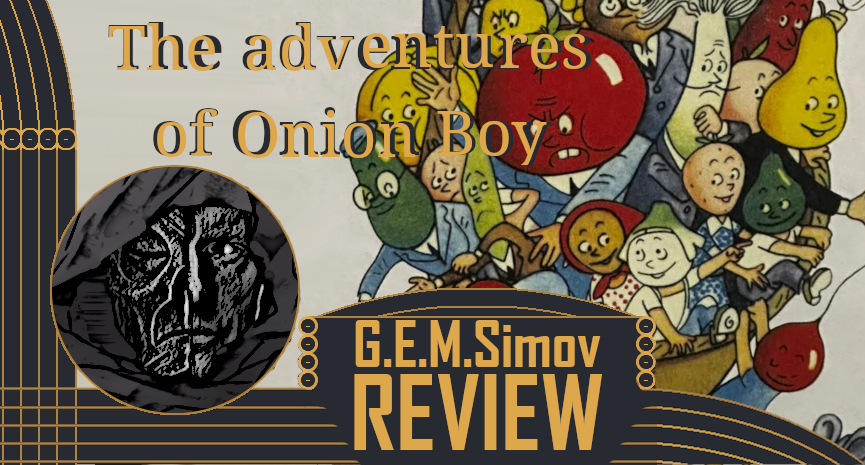
Hello everyone, I am the enjoyer of onions, G.E.M.Simov, a revolutionary so opposed to the tyrannical lemons I am willing to give my life in the fight against them, here to tell you about Gianni Rodari’s book “The Adventures of The Little Onion”.
Simple review details - I rank books on an out of 10 basis, granting up to 3 points in 3 categories, as well as a last, single point from my own self, depending on my experience with it.
Disclaimer - I read a translated edition of the book, and so some of the quirks I describe might be absent in the original, Italian version.
Content
First of all, this is a book that, frankly, cannot be read in English. That is owed up to the fact that the English language is so laughably incapable of conveying endearment and smallness that the Main Character in this book - The Little Onion - is called just that, in English.
In Italian, the little fellow's name is Cipollino, meaning that - endearing, loveable means of saying onion and ascribing a human-esque personality and quality to it. A single word - and boom, there's an entire character. In English, there are three words that need to be used, and even so they fail to convey the enormity of meaning contained in “Cipollino”.
Similarly, the language I read it in happens to also possess the incredible ability to bend and mold words, thus allowing for a 1to1 translation of the name, losing none of the meaning.
While this could be a grievance presented in the Richness of Expression part of this review, I feel as though it is important for the content of the book. Namely, it is important, because people are not very likely to pick up a book about a character “The Little Onion” - then again, there are such classics as “the hungry hungry caterpillar”.
Regardless, my concern here is that this book, aside from being a little foreign, is also adorned with such a lengthy name which bears very little personality. That leads into the fact that it might not be very appealing for English speakers, and so its content might wind up passed by.
And the content is a mixed bag, frankly. As a children's book, it does not put any great task ahead of itself. It does, however, endeavor to spark the revolutionary spirit in its little readers, which is quite nice.
All in all, the book is about revolution. It is about class struggle, about there being a class of stupendously rich and powerful folks, who are all nasty and horrible, which class of rulers - the aristocracy in this case - does dreadful, unjust things to the class beneath itself, to ordinary, non-nobles, non-aristocrats.
It's about realizing that the arbitrary laws of the nation one lives in are in place because they allow that particular class to control the rest of the population, and that these laws are always in favor of said ruling class. It is also about knowing those things and then acting upon that knowledge.
Stupendously, this book is sublime in the fact that it was written more than half a century ago, and yet it is still incredibly on point in regard to contemporary times. The very first chapter features the statement: “Good people go to prison, while villains and murderers rule.”
Of course, I am not directly quoting, but that's the sentiment. And so as I look towards any political landscape in any country, as the twenty first century's first quarter comes to an end, I find myself agreeing that, indeed - good people are in jail (ala Snowden) while villains, criminals and murderers are in power (ala the fortunately late Kissinger, Netinyahu, half of the political class in every “democracy” and even Donald Trump!)
So this book is very relevant to contemporary times, meaning that kids can read it and they will not even need to look to their parents for clarification - all they would need to do is watch the news, see the headline of a newspaper, or look eastward to Palestine or Ukraine.
Thus, Rodari's work is very simple and clear cut - just show off class warfare and antagonism, and in showing it off display that it is bad, and then present the solution, revolution, as the simple and easy way out of things as it is.
Does the author handle this task? On the one hand, he does. On the other, however, he also makes a few… Mistakes, or, rather, odd choices.
There's the guise of everything being either an animal or a plant - The Little Onion, Prince Lemon, Don Tomato, the Mole, the Bear - but then there is also some weird racism on display. At first it can be written off as the plant people being defensive against the animals, because the animals are shown off as, predominantly, nonverbal, animal Characters.
Then, however, as they talk and reason with the other Characters, things become confusing. Plant people go to jail, while animal…People(?) go to the zoo. Lastly, there is this one scene where the supposedly good guys experience such a violent, purely racist fit over the fact that a Bear is waving at them, and is riding the train, that I was left totally appalled.
It is a perfect depiction of racism. They are upset that the Bear is riding the train, that it has the gall to wave at them, to greet them, in a sense. They start saying that bears are such and such, that there is no way these bears are actually riding the train, that they are circus bears and their handler will show up any moment now…
And none of that is addressed! These Characters, who are shown off as rational and capable of speech and understanding, are treated so horribly in that one, supposedly joyful scene, that I was almost stunned.
The way that particular scene is resolved is that the bears are accompanied by the Main Character, and, suddenly, everything is fine. But there is the fact that the good guys do not recognize the Bear waving, even though they met less than half a month ago and had a very particular experience together… It is just bafflingly terrible.
Similarly, the book speaks of there being people who are simply bad, whose souls are wicked, and who are beyond redemption, or so it appears. While I vehemently dislike that, there is something else that Rodari does that seems to be very pleasant - he somewhat solves that.
Because, yes, while these people can be nasty and wicked by nature, if they are situated in a society that has surpassed class, then they will be far less capable of and prone to doing evil. It indicates that the power structures that exist in a monarchical society predispose the evil man, or even the common man, to deeds that are selfish and horrible to their fellows. Similarly, the power structures in monarchical societies are awfully similar to those in contemporary societies - the monarch owns everything, and so he rules; alternatively, the CEO, the investor, the capitalist owns everything, and so he rules… And does horrible things to his fellows.
Lastly, there's the problem of common folk turning against one another in pursuit of financial gain, of, dare I say it, some semblance of capital. In fact, this book allows itself to be nicely interpreted through communist theory.
With all that said, I think that the book about Cipollino, the Little Onion, is a very rich read for a child. In fact, it might even prove to be contextually valuable for an adult, too. Alas, it has some very problematic areas that make it difficult to score as high as possible. 2/3
Richness of Expression
Rodari has written this book in a nearly splendid manner. Whereas things in parentheses are rare, normally, herein they are very common. In fact, they really add a bit of spunk to the book.
The personality that oozes through, the fact that the book is actually told through the perspective of a lyrical speaker, rather than an omniscient and impersonal narrator, is very curious. On occasion Rodari, or the speaker, allows himself to share a thing or two about the events that are transpiring, and it is a very personal opinion that gets shared, however it is in a slightly snarky, friendly manner, one that refers to the reader with this friendly demeanor.
Now, as stated, the book has this magnificent quality of featuring the word (and other such magnificences) Cipollino. The more I think about it, the more pleased I am by the intense amount of meaning that word carries. Then there's the fact that the author took his time to pick out proper titles and certain veggies - most striking of which will forever be Don Tomato, but then there are prince Lemon and countess Cherry, or baron Orange and duke Mandarine. There is something entertaining about those names, and I quite like it.
In fact, the whole book is written in this magnificently excited manner that is so synonymous with children's books, and it is pleasant and light, easy to take in and easy to enjoy. Reading this book was a neat little adventure with a bunch of funky characters, all thanks to the richness of Rodari’s expression. 3/3
Story
Cipollino - The Little Onion - lives with his massive family in a small hut, in poverty. Then, his father winds up incarcerated for accidentally stepping on prince Lemon’s shoe - which happens, in part, because prince Lemon wanted the crowd around him to get riled up, to push and shove, and so Cipollino’s dad gets shoved and he does the deed.
Boom, incarcerated for life. Cipollino visits his dad and gets told to go learn of evil-doers and their ways, and is then spurred away by the jailer.
So Cipollino goes on a little trip, and reaches a funky little village with many interesting inhabitants and some problems, stemming from a certain castle on a hill, which features a pair of countesses, a don, a couple other characters and the Little Cherry Boy.
Then a grand adventure ensues, swirling around a house that gets moved and has its owner’s ownership of it come into question, then prison, then getting out of prison, then so on and so forth. New Characters constantly get introduced, new happenings occur over and over, and, in the typical children's book style, no one Character changes and develops.
That is not a bad thing in and of itself, but in the context of an adventure it is not that good, either. Sure, a Character can go on a hero's journey and remain unchanged, but the point of it is not to stay the same. Similarly, Cipollino starts off his journey, in theory, not knowing villains or their ways. However, as soon as he encounters villains, he knows how to deal with them, and he deals with them.
He has a few hiccups here and there, but never does he change. He is not wholly perfect, he goes through a sump, but he comes back as strong as before and manages to deal with the great problems through the help of his friends.
In fact, one of the main things in the story is that there's this mole lady who is so helpful that she winds up being a Deus Ex machina, because she's just a good person who wants to help, even if the situations she gets in as a result of helping are very unpleasant for her.
That mole lady doesn't get repaid for being that kind or good, regardless of how bothersome the adventures she has are, and there is never an encounter where the mole lady denies or is difficult. That's… It's just odd. Again, however, this is a children's book, and, similar to the mole lady, Cipollino is always good and willing to help, so perhaps it has these elements of teaching kids that if they are nice then everyone else has no reason not to be nice to them.
The best thing about this book is the conclusion, or, rather, how it happens. Of course, the mole lady is the key element, but then the people - completely unknown characters who do not get introductions - stage a revolution, thanks to the mole lady's efforts and Cipollino having asked her to do the things she does, and thanks to that revolution all the problems are solved.
That's… That is quite cool, even if it seems a bit flabby. After all, Cipollino only gets to ‘win’ thanks to his influence with the miner's union, if that can be phrased so. Then again, that's pretty neat - knowing people and being able to count on them. However, the fact that the moles are, well, animals, and the racist vibes that ooze off of the plants towards the animals… Problematic, to say the least.
With these things said, Cipollino’s adventures are very entertaining. They have a few missteps, but aside from that they are great. 2/3
Legendary Point
Does this book get the Legendary point, so craved and wanted by all and none at the same time?
I would have loved to say that it does, thanks to the fact it stokes revolutionary flames in the youth, but then it was not as weighty or impactful as I would have wanted it to be. I've read children's books that have this revolutionary fire in them, and which are stupendously more powerful in some regard.
Thus, NO, Cipollino does not get the Legendary Point, even if he will always dwell in the mind of yours truly thanks to the ever present, growing, red visage of Don Tomato. 0/1
Conclusion
7/10. Cipollino’s Adventures are a good read, especially for the younger kids here and there who are still learning how to. Additionally, it is a good read for parents who want to read to their kids… And it is nothing to scoff at for adults reading, either. Definitely brings a particular lightness with itself.
It makes its way onto the belt, a very pleasant accomplishment to marvel at. Still, it could have been so much more…