Zzzz-Zzzz-Zzzz | a Review
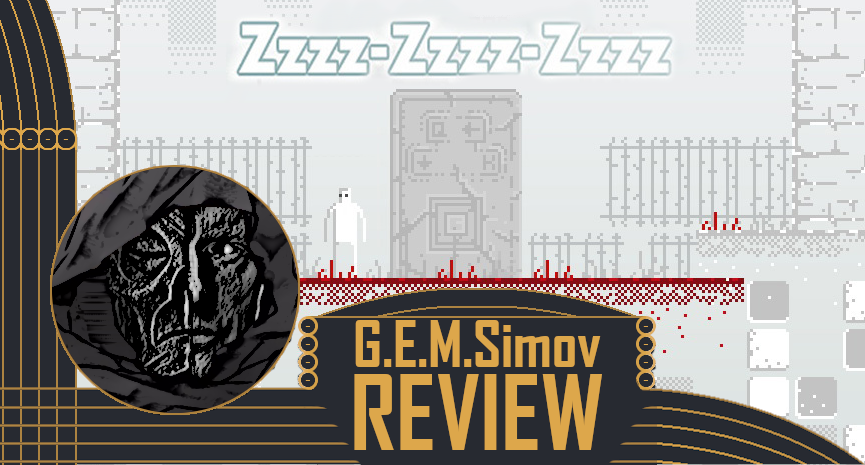
originally published on 22/08/2022;
Hello everyone, I am the sleepy philosopher game-designer, G.E.M.Simov, a goon that tends to enjoy sleeping, here to tell you about a game that goes by “Zzzz-Zzzz-Zzzz”, which could also be called “Triple-Quadruple-Z”, or simply “That game about sleeping”. Henceforth, I’ll refer to it as THE GAME. Sorry to those of you who lost!
Simple review details - I rank games on an out of 10 basis, granting up to 3 points in 3 categories, as well as a last, single point from my own self, depending on my experience with it.
Gameplay
How would this game even be described? An abstract indie puzzle platformer, perhaps? That ought to be able to tell the reader more than they need to know, as it is exactly that. When one sees it and comes to know it, that’s how it is described, yet it also feels as though that description is somewhat lacking, somewhat untrue.
It’s not that there’s no platforming, but the platforming is just there as a means of preserving the ‘game’ aspect of the game. It’s not that there’s no puzzles, but these puzzles face some issues that really make me wonder if they are, indeed, puzzles in the first place.
An example of the ‘game’ aspect being somewhat forcefully preserved would be one of the first levels the Player encounters. It’s a set of platforms, one-two-three, which go up, then repeat in the opposite direction, still going up, and then keep repeating infinitely. The Player is then tasked with jumping from platform to platform for a certain amount of time, whilst the abstract narration pops in… Creating a concept, which concept is being enforced by the platforms.
See, these platforms are endless. The Player Character can go up infinitely - which is precisely what the developer/game intends as a possibility - but in reality what is wanted of the Player is to consider the narration, conceptualize that, which is being spoken of, and then solve the puzzle - which puzzle is to fall down from the platform when new text stops appearing.
What indicates that this should happen? Well, nothing. But maybe there is something, as in a previous level the player similarly ascends a number of platforms and then gets told that there’s something down below, urging them to go back all the way down to see if there is something down below. There turns out to be something down below, which then creates the idea that the Player should backtrack, or maybe even lose their progress on purpose, to check for these newly appeared rewards.
So then the puzzle with the infinitely ascending platforms makes sense, does it not? That is true, it does. Then, following this logic, every consecutive puzzle in the game should have its solution hinted at in a previous ‘puzzle’ or level of the game, right?
Unfortunately, that is not the case. Naturally, due to the fact that this game is so tightly bound to dreams, one could argue that the fact a puzzle’s solution is not hinted at in a previous level, in a different dream, is indicative of the nature of dreams - after all, they are not all truly connected, are they?
Then, however, the game goes on and connects all dreams - in a literal sense, through a massive hub world - and in a less literal sense, but still relatively literal, as each dream comes as a point in a sequence of points. Sure, the sequences may be different, but the dreams do have connections to other dreams.
Yet there’s a large blot of lacking. Lacking in general, not lacking a certain thing. Maybe consistency, but that’s going to come slightly later.
The puzzles in the game are interesting. Almost all of them are somewhat simple, yet with that simplicity comes a measure of amusement. Then, there are the ones that don’t seem simple, the ones that appear obtuse beyond reason, the ones that seem hard for the sake of being hard.
Naturally, the game features a vast array of puzzles, a vast array of platforming sections, as well as a vast amount of waiting for things to happen. The first two things are good, the second one - not so much, but why?
Well, the game does not actually force the Player to wait directly, but does so indirectly. The Player Character (PC) moves painfully slowly. In most of the levels, the PC wobbles through at a most displeasing pace. If one was meant to experience the levels once, maybe twice at most, thn that would not be a problem, but due to the fact that the game’s puzzles are so plentiful that some span a multitude of dreams, there’s a very real likelihood that one will be forced to go through a level (dream) more than they would want to.
In addition to that, one can fail. Failure, then, requires repetition - as many of the dreams have different endings, or rather can lead to different points in the sequence of dreams, thus requiring to be played through a multitude of times. An example would be the ‘Depth’ dream, in which the Player can fail many times, whilst also having at least three possible conclusions to the dream.
What this creates is a very real sense of tedium. I am interested in finding out where this leads, how it gets resolved, but the act of finding that out it so bothersome that I don’t want to do it. The act of moving is so sluggish and unpleasant to partake in that I simply fail to enjoy it.
Unfortunately, that’s a very big issue. A humongous problem, actually, due to the fact that we’re talking about a game, and the most important thing in a game is the enjoyment of playing said game. That’s the ‘gameplay’ and its requirement to be good. In this game… That aspect is not good.
Sure, there are moments, levels, which feature increased mobility, which are a lot more enjoyable to go through than the other levels, but they are rare. Then, the issue is exasperated by the fact that there’s a ‘Reward’ system, which reward system features ‘improvements’.
One of those is the ability to fly in SOME levels. Not all, but some, according to the Reward. Unfortunately, that SOME means… The Hub world and that one level in which you unlock the reward. There’s the Reward letting you run, but then out of 10 levels you can only run in 3.
Supposedly, the Player is rewarded by the game for doing certain things, for finding secrets or going out of their way to do something specific - like jumping 200 times on a button - but then that reward is not actually a reward, because it does not really take effect.
Frankly, that’s disappointing. The game has interesting ideas, some are executed in interesting ways, but, alas… It isn’t that good a game. 1/3
Presentation
This game was made by one person, largely, and thus it does not look like a massive project undertaken by a large group of people. Resultant, then, is the fact that the game does have some issues in its presentation, which issues, however, are somewhat slight. Mainly, I’d have to say that the characters (all of them) look goofy.
However, aside from that, the main BIG issue is housed within the ‘Controls’ section of the game, wherein the Player can change their controls. The act of changing the controls requires the Player to situate the Player Character in a specific location, wait for a bit, and then press the button they would like to change the currently selected input to.
That was not well conveyed. Initially, when I tried doing something with the controls - changing them - I walked as far into the indicator showing the current button used as a means of inputting the command I wanted to change, whilst pressing the ‘interact’ button. Unfortunately, nothing happened, so I figured the controls could not be changed and this mechanic was broken.
Only later, by accident, did I realize that one needs to stand in a specific location - which is, admittedly, highlighted in a sense - wait for a sound and visual queue, and then change the selected control. That one was, strangely, not that well communicated.
Other than that, though, there seems to be nothing I can point at and say that it is a problem. Though, maybe there is another one that is a problem, but not in a sense that affects Gameplay quite like the previous example.
In a ‘funky’ scene, in which a character (called Hillary Putnam, funnily enough) recites a LONG bunch of philosophy from the book “Reason, Truth and History” by Hillary Putnam, which bunch of text is the first chapter of the book - “Brains in a vat”.
While reading that excerpt in the game was very entertaining and quite stimulating, the rate at which the text flows by is a bit too fast for proper reading. Not only that, but rather than going down, it goes… Up-down. Whereas in normal literature the text goes from the left to the right, from the top of the page to the bottom, in this one the text went from left to right, but it went from the bottom of the ‘page’ to the top, thus creating a very confusing visual.
It was an interesting visual, but quite unpleasant in the sense that it impeded my ability to read through the text properly. Quite a shame, as the text is very interesting!
Other examples don’t come to mind, due to the fact that I think they are not very applicable. Sure, one could argue that the puzzles in the game were very obscure and purposefully obtuse, as a means of implementing proper challenge, with there being little indication that something has changed, but that could also be part of the message of the game, part of its theme.
Then there’s the sound of the game. It is not exceptional, it is not something truly amazing, but it is not bad. It is reasonably neat, it is reasonably pleasant to listen to, when one is not listening to it on a lengthy loop over the span of at least 20 minutes (while trying to reading the excerpt from Hillary Putnam).
In small, bite-sized chunks, the music in the game is quite excellent. Whenever one starts experiencing it over and over again, though, that’s when it starts becoming a bit draining… Droning… Grating.
The Sound Effects (SFX) are decent, too. The rest of the visuals, with the exception of the lanky and weird humanoid characters (who could look like that on purpose) are very neat. Brains in Vats, mini-guns, spinning saw-blades… On top of that, the use of color is quite splendid. I must admit that this game is charming, even if it isn’t as magnificently beautiful as it could have been (owed up to the issues I pointed out earlier). 2/3
Story
Does this game have a story? Well, if you judge from what I said about it in the ‘Presentation’ part of this review, it definitely does. But, then, if you judge from the game itself, I lose that definitiveness, that certainty.
In a sense, there is a story. There is a causality related to events, with one thing leading to another, there is some kind of goal that gets uncovered at one point, but…
It’s an abstract game. And, as such, things in it are going to be abstract, or, at the very least, they will lean on surrealism, making them a tad more difficult to comprehend and/or piece together.
This is a game about dreams. The Player Character is dreaming. That same PC, however, wants to get out of the dream. Doing so is not easy, though through their adventures in the dream, they find a way out. It turns out, however, that it was not a way out, but rather the dream simulating reality - a pseudo reality. Then, the PC manages to actually get out of the dream, but finds out that reality is not worth it. One should stay in the dream… Then again, though, could it be that reality was also a dream?
This game is a means of looking at dreams as a concept, it attempts to deconstruct the concept of a dream and even ontologize it, in a sense. There’s plenty of interesting stuff to be considered, but is there a whole story?
Well, there is. There are at least six of them. Maybe even eight, but that’s all somewhat dependent on the interpretation one has of the game’s endings. Does the dream end with the ending, with the collection of a core, or does it continue? If so, then does the dream end when the dreamer awakens, or does it not end? Is the story that of one who collects all cores, or is the story that of one who dreams of the cores, only to awaken?
Is reality that, which is said to be reality, or is it not? Is reality the massive quantity of brains in vats, or is it the burned, dead world, or is it the abandoned workshop, or is it the darkness of hell? This one is very rich in interpretation, allowing one to derive whatever meaning they desire from it. As such, I quite enjoyed it, even if I feel as though something is missing. 3/3
Legendary Point
Does this game get the legendary point, so craved and wanted by all and none at the same time? I’m going to have to say YES, this game gets the legendary point. I don’t know if I would have given it the point if it had not spent half an hour telling me about Brains in a Vat, but because it did, I’m going to have to say that this game does get the point.
Not only because of the Brains in a Vat meme, mind you. I quite enjoy abstract things, and this one presented these abstract ‘things’, maybe even ‘concepts’, in a very appealing manner. The visuals it presents, as mentioned in the ‘Presentation’ part of this review, are quite neat, even if they are pixel-art… Or maybe because they are pixel-art…
In any case, I enjoyed this game. I thought it was going to be some stinky, short little blast through, and it wasn’t a lengthy crawl, but it was definitely something engaging and entertaining. Now, if only the “Rewards” system from the game was doubled as Steam Achievements… That would’ve been cool! 1/1
Conclusion
7/10. This is not a good game, but an impressively interesting experience. Thus, I would not recommend playing the game, unless you are a massive fan of indie puzzle-platformers. Otherwise, just watch a play-through of it, and you’ll still get everything that needs to be gotten… Maybe everything, safe for Hillary Putnam’s Brain in a vat.
I tuck it under my belt, another shining achievement that I proudly display. If only it were more polished…